Thursday, February 9, 2017

Breakfast Rolls: The School at the Chalet, Elinor M. Brent-Dyer, Harper Collins

The School at the Chalet, Elinor M. Brent-Dyer, Garper Collins

Food in books: breakfast rolls from The School at the Chalet


Kate Young seeks some escapist fiction and bakes a breakfast enjoyed by the children in the Austrian boarding school in Brent-Dyer’s novel
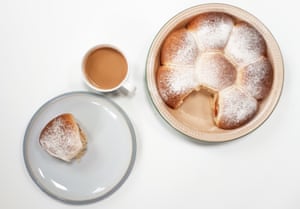

Breakfast rolls from The School at the Chalet. Photograph: Kate Young of The Little Library Café

The boarders of the Chalet School always declared that Sunday was quite one of the best days of the week. To begin with, they could stay in bed until nine o’clock if they were so minded. Then, after their breakfast of coffee, rolls, and honey, they all assembled in the meadow which ran from the lake edge to the pine wood, and Madge read aloud to them for an hour.
---

Perhaps, like me, you need a bit of escapist fiction this week. A warm, comforting, charming story – maybe one featuring a group of teenage girls attending a tiny, fledgling school in Austria, eating rolls and coffee for breakfast, and hiking through the Alps?

A friend gave me a copy of The School at the Chalet, the first in the extensive Chalet School series, when she discovered I’d never read them as a girl. It’s exactly the sort of series I would have committed myself to collecting during childhood. If you’ve never read them before, I heartily recommend doing so.

Twenty years ago, it is the cohort of schoolgirls who would have held my focus, with their politics, friendships and the challenges they come up against. Reading it as an adult, twentysomething Madge is the one I am fascinated by: faced with a limited budget, a brother in India, and a little sister to take care of, she decides to move to Europe, and start a small school. It is an extraordinary plan, and one that has filled me with a desire to copy it to the letter.

I have always loved teaching. I studied drama and education at university, and moved to London hoping to find a career in theatre. But I also had to pay rent, so spent my early months here teaching science in a school. Though I have long moved on from working in formal education settings, teaching remained a part of my career: from projects with young people in theatres, to my current role as a nanny.

I discovered early on that it is informal education I really relish playing a part in - the kind that happens incidentally, almost by accident. Using fractions to measure out ingredients when making a batch of pancakes. The language we pick up through new stories, read aloud before bed. Questions about the natural world asked, investigated, and answered on cold morning walks to school. Though Madge takes her planning and curriculum seriously, it’s this sort of learning they have time for at the Chalet School.

Like in all good boarding school novels, the girls also eat particularly well. In trying to recreate these buns, I have gone for the sweetest, softest, most delicious version I could imagine. They are filled with plum jam, which the girls at the Chalet School always seem to have a pot of. They’re perfect dipped into a strong and milky coffee on slow Sunday mornings. Though I encourage you to eat them straight out of the oven, they will keep for a couple of days in an airtight box.
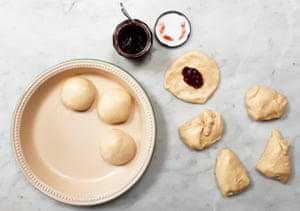
FacebookTwitterPinterest Photograph: Kate Young of The Little Library Café
Buchteln and Coffee


Advertisement


Serves 8

Ingredients
150ml whole milk
100g unsalted butter
50g golden caster sugar
15g fresh yeast (or 5g easy action yeast)
1 egg
1 egg yolk
175g plain flour
150g strong white bread flour
Pinch salt
60g plum jam
1tbsp icing sugar

Equipment
Saucepan
Whisk
Mixing bowl
Wooden spoon
Ovenproof dish (like a pie dish or roasting dish)
Sieve

1. Put the milk and 75g of the butter into the saucepan, and warm over a low heat until the butter melts. Take off the heat, and leave to cool until it is lukewarm. Whisk in the sugar, then the yeast. Add the egg and egg yolk.


2. Put the flours and salt in the mixing bowl. Tip the liquid ingredients in, and bring together into a dough using the wooden spoon. Knead it for 10 minutes until it is smooth, elastic, and bounces back when you prod it. The dough will be sticky, but do add a small amount of flour to help your kneading if required.

3. Wash out the mixing bowl, grease it with butter, and place the dough in it. Cover and leave to proof for an hour, until doubled in size.

4. Weigh the dough, and cut it into eight even pieces. Flatten each (not too thinly in the centre, or the dough might split), place a teaspoon of plum jam into the centre, and pull the edges up. Pinch them together, then flip the ball and roll it on the work surface. Place each in the greased oven dish, not quite touching the others. Allow to proof for around 40 minutes, enough to let the rolls join up, and until they bounce back when prodded.

5. Preheat the oven to 180C. Melt the rest of the butter, brush it over the rolls, and bake for 20-25 minutes, until risen and golden. Dust with icing sugar, and serve with honey, and sweet, milky coffee.

Tuesday, February 7, 2017

DUCK A L'ORANGE


Image result for DUCK A L'ORANGE


INGREDIENTS

For duck
1 tablespoon kosher salt
1 teaspoon ground coriander
1/2 teaspoon ground cumin
1 teaspoon black pepper
1 (5- to 6-lb) Long Island duck (also called Pekin)
1 juice orange, halved
4 fresh thyme sprigs
4 fresh marjoram sprigs
2 fresh flat-leaf parsley sprigs
1 small onion, cut into 8 wedges
1/2 cup dry white wine
1/2 cup duck stock, duck and veal stock*, chicken stock, or reduced-sodium chicken broth
1/2 carrot
1/2 celery rib
For sauce
1/3 cup sugar
1/3 cup fresh orange juice (from 1 to 2 oranges)
2 tablespoons white-wine vinegar
1/8 teaspoon salt
2 to 4 tablespoons duck or chicken stock or reduced-sodium chicken broth
1 tablespoon unsalted butter, softened
1 tablespoon all-purpose flour
1 tablespoon fine julienne of fresh orange zest, removed with a vegetable peeler

Special equipment: an instant-read thermometer; a 13- by 9-inch flameproof roasting pan
1 13- by 9-inch flameproof roasting pan


PREPARATION
Roast duck:
Put oven rack in middle position and preheat oven to 475°F.
Stir together salt, coriander, cumin, and pepper. Pat duck dry and sprinkle inside and out with spice mixture. Cut 1 half of orange into quarters and put in duck cavity with thyme, marjoram, parsley, and 4 onion wedges.
Squeeze juice from remaining half of orange and stir together with wine and stock. Set aside.
Spread remaining 4 onion wedges in roasting pan with carrot and celery, then place duck on top of vegetables and roast 30 minutes.
Pour wine mixture into roasting pan and reduce oven temperature to 350°F. Continue to roast duck until thermometer inserted into a thigh (close to but not touching bone) registers 170°F, 1 to 1 1/4 hours more. Turn on broiler and broil duck 3 to 4 inches from heat until top is golden brown, about 3 minutes.
Tilt duck to drain juices from cavity into pan and transfer duck to a cutting board, reserving juices in pan. Let duck stand 15 minutes.
Make sauce:
While duck roasts, cook sugar in a dry 1-quart heavy saucepan over moderate heat, undisturbed, until it begins to melt. Continue to cook, stirring occasionally with a fork, until sugar melts into a deep golden caramel. Add orange juice, vinegar, and salt (use caution; mixture will bubble and steam vigorously) and simmer over low heat, stirring occasionally, until caramel is dissolved. Remove syrup from heat.
Discard vegetables from roasting pan and pour pan juices through a fine-mesh sieve into a 1-quart glass measure or bowl, then skim off and discard fat. Add enough stock to pan juices to total 1 cup liquid.
Stir together butter and flour to form a beurre manié. Bring pan juices to a simmer in a 1- to 2-quart heavy saucepan, then add beurre manié, whisking constantly to prevent lumps. Add orange syrup and zest and simmer, whisking occasionally, until sauce is thickened slightly and zest is tender, about 5 minutes. Serve with duck.


NUTRITIONAL INFO


Calories1441
Carbohydrates29 g(10%)
Fat128 g(197%)
Protein38 g(77%)
Saturated Fat44 g(219%)
Sodium1814 mg(76%)
Polyunsaturated Fat16 g
Fiber3 g(12%)
Monounsaturated Fat60 g
Cholesterol249 mg(83%)
per serving (4 servings)Powered by Edamam

Too bad about the kippers

Herbed scrambled eggs for breakfast, from Jeanine Larmoth, Murder on the Menu, prepared by me (the cook)
served by me (the butler), consumed by me & Len (residents of our fine mansion).
No mysteries here for the moment, unless you count the question of how the stock market will do today.

Here's the recipe I used. Yes, I meant to include Kippers, which I bought yesterday. But ...
Alas, when I looked at the package, I realized that somehow  -- although I bought them yesterday --
these kippers were 6 years out-of-date. I was afraid to open them, and will take them back to Whole Foods!
Note: the scrambled eggs were very good. But I'm afraid we didn't come near to reproducing the atmosphere described by Agatha Christie or Dorothy Sayers. I'll try again to make something from one of my mystery cookbooks!

Next step: watch more TV dramatizations of these mystery stories. I was amused at one scene that I already watched in "Hickory Dickory Dock."  Poirot (played by David Suchet) was having his usual Continental breakfast with his houseguest Inspector Japp, who says "I say Poirot, don't you have any bacon and eggs?"

Saturday, December 24, 2016

Food and The Nine Tailors

The beginning of the 4-part TV series "The Nine Tailors" --
a 1914 wedding in British upper class splendor.
The TV series "The Nine Tailors," originally broadcast on the BBC in 1974, begins with an opulent wedding. In the impressive reception hall of a fine country mansion, servants are placing the wedding cake and a remarkable collection of sweets on the buffet table. The night after the wedding, which took place in 1914, the mansion's butler and his accomplice steal a £60,000 emerald necklace from one of the guests. Lord Peter Wimsey, played by actor Ian Carmichael, is a guest at the wedding; he chases the fleeing suspect in a fast car.

The first episode of the TV series continues with the experiences of Peter Wimsey in the trenches of Word War I, providing the back-story of his relationship to his incomparable gentleman's gentleman, Bunter. It's a very dramatic and fast-paced hour of drama. Only at the very end of this episode do we go forward 20 years to 1934, when Wimsey and Bunter crash their car into a snowdrift in the same little town -- the point in time where the original novel by Dorothy Sayers begins. I find this rearrangement of flashbacks in the book into an exciting first episode to be very effective and enjoyable.
Ian Carmichael as Lord Peter Wimsey. 
From the second episode onward, the TV drama follows the book quite closely, continuing to dramatize every possible action scene with enthusiasm. In fact, this TV treatment seemed so exciting that we watched all 4 episodes in one night. 

I've already written about my visit to the prototype of the little town and the church that is central to the plot of Sayers' book. I believe that some of the filming was done at that location or at least using a reconstruction of that church. If anything, this treatment an improvement over the book, as the long-winded digressions on bell ringing and other technical subjects were condensed sufficiently to contribute to the plot without retarding the action. Even though I don't find the sound of pealing bells particularly appealing, it's much nicer to hear them than to read about them!

The Five Red Herrings, another Lord Peter Wimsey novel, was also made into a BBC TV series with Ian Carmichael as the detective. I also watched it recently, but did not like it nearly as well -- in fact, I found the acting wooden and dialog too staged, which is odd since it dates from only a year later. The actors in "Nine Tailors" seemed much better suited to their roles, especially the character parts like the Rector, his wife, the doctor, and the eccentric village people.

For all my blog posts about Dorothy Sayers, including this one, click here.

Monday, January 25, 2016


Saint Wendreda and the Nine Tailors

Lord Peter Wimsey again! The Nine Tailors is the only Dorothy Sayers mystery that I remember reading in the past, and I decided to read it again. It's quite long for a detective novel, and contains enormous detail about English bell-ringing. The bells are central to the plot, but I eventually found the technical descriptions about them a bit tedious.

If you aren't familiar with the terminology, "tailors" are peals of the bells: it was a tradition to ring the bells of a village church tower nine times to mark a village man's death. Specifically, amateur detective Lord Peter Wimsey spends a lot of time in a village where the Rector is obsessed with ringing changes on the bells of the local church. He himself participates in a 9-hour sequence of bell ringing to bring in a New Year; that is, pealing the bells in various mathematical and not necessarily musical sequences. At least now I know why I have never understood what I was hearing when bells ring in the New Year or something -- always sounded like noise to me.

The Nine Tailors also contains quite a bit of description about the architecture and decoration of the church whose bell tower is involved. This, I found more interesting, because I once visited the church that was the prototype for the fictional building. Its main feature is an "angel roof" with 120 wooden sculpted angels at the ends of the hammer beams that support the roof. Friends who were very dedicated Dorothy Sayers fans took us on a tour of places of importance to her novels. Some photos of that tour (March 13, 1999) --


The angel roof of St.Wendreda's church in March, England, prototype of the church in The Nine Tailors. 
Our friends Sheila and John with the key to the angel roof church.
We had to ask at the local pub "The Stars" to obtain the key. 
Churchyard of St. Wendreda's. The keys to the church and the cemetery are both plot elements in The Nine Tailors. 
St. Wendreda's church tower.
Mae and John looking over the church.
To return to the novel: the Rector and the village inhabitants in The Nine Tailors are all very deferential to Lord Peter Wimsey, as Wimsey's family are the local nobility -- his brother is the Duke of Denver, the local area (fictitious). Although the term isn't used, Wimsey is very condescending in the old sense, which meant the way a noble is actually supposed to treat his inferiors. I am rather fascinated by the way the word has evolved from praise for the behavior of a person who was born into a socially superior stratum to criticism for a person who acts as if he was born superior, and expects to be treated as such! This mutual view is reflected, I think, in the way the Rector and his wife offer meals to Wimsey:
  • "Can you eat shepherd's pie?" she asks. "You're sure? The butcher doesn't call today, but there's always cold ham." (p. 51)
  • "The butcher says he has some nice calf's liver today, only I don't know if you can eat it," she says on a later occasion. "Theodore is very fond of liver-and-bacon, though I always think it's rather rich." (p. 187)
  • After singing hymns on Christmas Eve, Wimsey returns to the Rectory with the Rector, his wife, and others "to eat cold roast beef and trifle." Not his usual French-style menu! By this time, Wimsey is being nobly helpful to the locals, and no apology seems needed when they share their meal with him. (p. 377)
The novel's time frame spans an entire year, which allows a vast amount of detail (maybe too much for me) about life in the village while a murder mystery is being solved. I also found the level of detail about the drainage systems in the fens of England to be a bit excessive, though rising water when the sluices are breached causes some of the most exciting scenes in the novel, as well as requiring another type of bell ringing: sounding an alarm. On our tour of the area, we also looked at some of the dykes and sluices that keep the former wetlands from being flooded.

If you decide to read The Nine Tailors expecting the usual pace of detective fiction, you must be quite patient! But tastes vary -- I've become a bit weary of both the pace of these novels and the extreme class-orientation they show. However, I'm planing to watch the TV series that was made of this book in the 1970s.

Sunday, January 24, 2016

Tuesday, December 20, 2016

Stephen Darori Spicey Chicken Rubs


Total Time:
Prep:5 min
Inactive:20 min
Cook:15 min


Yield:4 servings
Level:Easy

Ingredients
Israeli Spice Rub:
1 1/2 tablespoons (1 1/2 palmfuls) sweet paprika
1 1/2 tablespoons (1 1/2 palmfuls) ground cumin
1 teaspoon (1/3 palmful) dried oregano
1 teaspoon (1/3 palmful) ground coriander
1/2 to 1 teaspoon crushed red pepper flakes (medium to hot in spice level)
1 1/2 teaspoons (1/2 palmful), coarse kosher salt
4 boneless, skinless chicken breasts (split, 8 pieces) 1 1/2 to 2 pounds
Extra-virgin olive oil, for drizzling
Warm pita or flat bread, for passing
Serving suggestions: Serve with tomato relish and zucchini (recipes follow). Piling the relish and the chicken in a warm pita is a fun way to combine the flavors and textures of the many.
Orange and Yellow Tomato Relish:
3 vine ripe or small round red tomatoes
2 orange or yellow tomatoes
1 small sweet onion, thinly sliced
1/2 cup (2 handfuls) flat-leaf parsley leaves, chopped
Dressing:
3 tablespoons (a couple of glugs) extra-virgin olive oil
1 ripe lemon, juiced
1/2 teaspoon ground cumin
1/2 teaspoon ground coriander
1/2 teaspoon crushed red pepper flakes
Kosher salt
Zucchini with Mint and Parsley:
4 small, tender zucchini, about 1 1/2 pounds (look in organic section of produce counter)
3 tablespoons (3 turns around the pan) extra-virgin olive oil
3 cloves garlic, minced
1/4 cup (half a bundle) chopped fresh mint
1/2 cup chopped flat-leaf parsley leaves (a couple of handfuls)
Kosher salt and pepper

Directions
Israeli Spice Rub:

For the spice rub combine the paprika, cumin, oregano, coriander, crushed red pepper flakes, and kosher salt in a bowl. Place in a sealable jar, keep in a cool dry place for up to 6 months.
Place chicken in a shallow dish. Drizzle with extra-virgin olive oil to barely coat the meat. Rub chicken liberally with 4 tablespoons of the spice blend. Let stand 10 minutes.
Grill chicken 6 or 7 minutes on each side or until juices run clear.


Dressing:
Seed and chop the tomatoes and combine with onion and parsley in a shallow bowl. Combine oil, lemon juice, and spices in a small plastic container with a lid. Shake dressing to combine and pour over salad. Season salad with kosher salt and toss to combine well. Let stand 10 minutes and serve.
Yield: 4 servings

Zucchini with Mint and Parsley:

Heat a large skillet over medium heat. Cut zucchini into 1/4-inch slices. Add oil, garlic, and zucchini to pan and saute 7 to 8 minutes, turning occasionally with a firm shake of the skillet, until zucchini are just tender. Add mint, parsley, salt, and pepper, and cook 1 minute longer. Remove from heat and serve.

Yield: 4 servings

Wednesday, November 23, 2016

Rugalach: Its History and Auntie Eddie Kaplan Wack's Rugalach Recipe


How to Make Chocolate Rugelach, a Favorite Jewish Pastry


Rugelach (/ˈruːɡələx/; roo-ge-lahkh; Yiddish: רוגעלך‎) and Hebrew: רוגלך‎‎), other spellings: rugelakh, rugulach, rugalach, ruggalach, rogelach (all plural), rugalah, rugulah, rugala, roogala (singular), is a Jewish pastry of Ashkenazic origin. It is very popular in Israel, commonly found in most cafes and bakeries. It is also a popular treat among American and European Jews.

Traditional rugelach are made in the form of a crescent by rolling a triangle of dough around a filling.Some sources state that the rugelach and the French croissant share a common Viennese ancestor, crescent-shaped pastries commemorating the lifting of the Turkish siege,possibly a reference to the Battle of Vienna in 1683. This appears to be an urban legend however, as both the rugelach and its supposed ancestor, the Kipferl, pre-date the Early Modern era, while the croissant in its modern form did not originate earlier than the 19th century (see viennoiserie). This leads many to believe that the croissant is simply a descendant of one of these two.

An alternative form is constructed much like a strudel or nut roll, but unlike those, the rolled dough and filling are cut into slices before baking

The name is Yiddish, the Jewish language of eastern Europe. The ach ending (ך) indicates plural, while the el (ל) can be a diminutive, as, for example, shtetlekh (שטעטלעך, villages) is the plural of shtetl (שטעטל, village), the diminutive of shtot (שטאָט, town). In this case, the root means something like "twist" so the translation would be "little twists," a reference to the shape of this cookie. In this context, note that rog (ראָג) means "corner" in Yiddish,. In Polish, which influenced (and was in turn influenced by) Yiddish, "róg" can mean "corner", but can also means "horn"—both the kind on an animal and the musical kind. Croissant-shaped pastries, which look like horns, are called in Polish "rogale" pl:Rogal świętomarciński. That word is almost identical in pronunciation and meaning to the Yiddish "rugelach".

Alternatively, some assert that the root is rugel, meaning royal, possibly a reference to the taste. This explanation is in conflict with Yiddish usage, where the word keniglich (קעניגליךּ) is the dominant word meaning royal.

Finally, in modern Hebrew, they are known as roglìt (רוֹגְלִית), a post biblical Hebrew word meaning "trailing vines", though the name rugelach (רוגלך) is still commonly used by Hebrew speakers.  The Yiddish word ruglach probably came first. The modern Hebrew is probably a neologism, chosen for its similarity to the Yiddish and its descriptive meaning.

This much-loved Jewish cookie is ubiquitous in Israel nowadays, where varieties range from average pastry at neighborhood grocery stores to gourmet delicacies at the country's best bakeries. This recipe takes the treat up a notch.

Rugelach, a much-loved Jewish pastry, is ubiquitous in Israel nowadays, where varieties range from merely-average cookies sold at neighborhood grocery chains to gourmet delicacies at the country’s best bakeries.

This lightly yeasted pastry has its roots in the Ashkenazi communities of Eastern Europe, where it was made with traditional fillings such as fruit jams, poppy seed or nuts. From there, it followed Hungarian and Polish Jewish immigrants to Israel and the United States.

But the versions prepared in each country diverged. American bakers, in the name of convenience, substituted a sour-cream or cream-cheese dough in place of the yeast dough.


Professional Israeli bakers, on the other hand, took the pastry up a notch – making an all-out laminated yeast dough just like that used for croissants, with many thin layers of butter.

While rugelach is popular year-round, it's also traditional to eat it over Hanukkah, along with the fried foods eaten for the holiday.

The secret to bakery-quality rugelach is just a little advance planning. Leave yourself extra time, in order to make the dough a day in advance, and let the dough rest as needed between steps. This makes the dough more manageable and pliable, which is necessary when you’re rolling it out into the fine, butter-filled layers that give these pastries their lovely texture.

Auntie Eddie Kaplan Wacks's Rugalach Recipe: 
After my folks abandoned me for Israel the for Kaplan sisters ( my father's first cousin) alternated in inviting me for Friday night dinner . The youngest Anita Kaplan Dubowitz relied entirely on her wonderful maid and companion and the meals tended to be Chicken Pies and deserts indigenous to the Cape Coloured Community , Sylvia Kaplan Schiff's roast were excellent and always to perfection. Auntie Lakey Kavalsky meals tened to be fish and always milkadik.Dinning with her was as close as I have got to dinning with Elizabeth R at one of her state Banquets. Her home was filled with antiques and she had a quite elegance unmatched by any of her sisters especially Aunt Eddie Kaplan Wacks who loved to bobamise with a down to earth lack of tact...... farible updates  she narrated with excellence and spice, always adding new twists.   But it was the seating  arrangement that I always found most amusing. there was the large adult table where she , her hubby and son and daughter-in-law Leslie and Rhona wacks sat  and there was the bridge table where  I was directed and sat with her grandkids Samara and Rael Wacks ( a decade or more younger than me) sat. I , the in my late 20's used to ponder whether entrance to the adult table was 30, 35, or 40. 

So one Thursday she canceled me without a bobmise that would lead to a small fabrible with her but then said she was baking a fresh batch of rogalach and I should pop in and get so. I did and between telling me about bridgehands and sending garooses to my folks and sister Leah, Lena, Lousiana , Lacey, Lala but any never remembering her name was actually Lesleigh ( the same as her only son) , I got the Kaplan Heritage Recipe  for rugalach.

Recipe Makes 20-24 rugelach pastries.

Ingredients
For the rugelach dough:


2 cups flour

2 tbsp sugar

1/4 teaspoon yeast

1 large egg at room temperature

1/4 cup softened butter (50 grams(

1/2 teaspoon vanilla

1/3 cup milk

For folding the dough:

100 grams softened butter (1/2 cup)

For the rugelach filling:

1/4 cup chocolate

1/4 cup softened butter (50 grams)

1/4 cup sugar

2 tablespoons cocoa powder

For the glaze:

2 tablespoons sugar

2 tablespoons water

Directions

Ideally, start a day before you plan to make the rugelach. Put flour in a bowl. Add yeast, sugar, softened butter, egg and milk. Mix to form a dough. Add a bit more flour or milk if needed, a teaspoon at a time, until the dough comes together as a soft, but not sticky, ball. Knead for a few minutes, and then set aside. Wrap in plastic.

Let the dough rest in the refrigerator for a minimum of one hour, but ideally overnight.

On the day you want to make the rugelach, preheat the oven to 180 degrees Celsius (350 degrees Fahrenheit).

Take out the dough, and let the butter soften until room temperature. Lightly flour a large work surface. Roll out the dough into a large rectangle. Spread evenly with the butter, leaving the edges clean. Fold into thirds (left and right), and then fold into thirds again (top and bottom). Re-wrap in plastic, and refrigerate for at least 30 minutes.

In the meanwhile, make the filling: Put the chocolate and butter in a microwave-safe bowl, and microwave for 30 seconds, until it starts to melt. Mix in the sugar and cocoa until smooth. ( the original recipe was melt in a dish on the stove)

Take the dough out of the fridge, and roll it out into a long rectangle about 30 centimeters (12 inches) deep and 3 millimeters (1/8 inch) thick. Spread with the filling, leaving the edges clean. Fold in half lengthwise, so that the rectangle becomes a long strip about 15 centimeters (6 inches) deep. Roll out lengthwise a bit more, until the dough is close to 3 millimeters (1/8 inch) thick again.

Using a sharp knife, cut the dough into elongated, 15-centimeter (6-inch) long triangles with bases of 6-7 centimeters (2 inches). Starting at the base of each triangle, roll into a croissant shape. Arrange finished rugelach on a baking sheet covered with baking paper.

Place the rugelach in the oven, and bake until lightly golden, 20-25 minutes.

While the rugelach are baking, prepare the syrup: Bring sugar and water to a boil in a small saucepan.

When rugelach are golden, remove from the oven and brush with syrup.


Tuesday, November 22, 2016

Rosh Hashanah Menu: Sephardi, Ashkenazi, Asian or Israeli


Roasted chicken and eggplant in pomegranate and date molasses Vered Guttman

Sephardi Rosh Hashanah seder

Sephardi and Mizrahi Jews start the Rosh Hashanah meal with a series of symbolic foods.

Each of the foods, including black eyed pea, squash, pomegranate and dates, are accompanied by a blessing, called Yehi Ratzones (Yehi ratzon, meaning “May it be your will” in Hebrew), based on their name in Hebrew or Arabic.

Here are the accompanying blessings.


Chilean sea bass, prickly pear and mint ceviche


Contemporary Israeli style Rosh Hashanah menu

Celebrate the Jewish new year with innovative recipes featuring bright Mediterranean ingredients.
Image result for Rosh Hashanah Menu: Sephardi, Ashkenazi, Asian or Israeli

Spicy carrot kugel.Dan Perez

Ashkenazi Rosh Hashanah menu

Make this new year meal about Eastern European Jewish comfort food, with some traditional recipes and some with a twist.
Image result for Rosh Hashanah Menu: Sephardi, Ashkenazi, Asian or Israeli
Pho-chicken soup with kreplach dumplingsVered Guttman

Asian Rosh Hashanah menu with an Israeli touch

Make this Jewish new year dinner unconventional with these Asian-inspired holiday recipes.