Showing posts with label #darorifoundation. Show all posts

Saturday, September 23, 2017

Memphis Kosher 20 Karlibach St., Tel Aviv Tel: (03) 901-7896

Image result for Memphis Kosher 20 Carlebach St.
Newly observant restaurateur Ori Melamed was having trouble finding a premium kosher hamburger.


“I know what an excellent hamburger tastes like,” says the ba’al teshuva, “and my search for a kosher one was unsuccessful. I knew the market was there, so I decided to make one myself.”

Melamed got to work on a recipe, found a location near the Tel Aviv Cinematheque and set up shop a few months ago. The hamburger meat is ground on the premises from four different prime cuts of beef, plus a little bit of fat for the flavor. The meat is glatt kosher, while the overall kashrut supervision of Memphis is overseen by the Rabbinate.

There is really only one burger on the menu, available in four sizes, with a choice of three toppings and two sides. For that reason, there is no printed menu but a blackboard with weights and prices. For the time being, the board is only in Hebrew; but Melamed, who has lived in the US, is happy to explain things in English.

The burgers come in patties that weigh either 180 or 250 grams (NIS 45 and NIS 55, respectively). There is also the option to double either size.

Meals consisting of a burger, fries and a drink start at NIS 55.

The Memphis burger lives up to the adjective “premium.” The thick burger has a slightly crusty exterior, while the inside is juicy and flavorful. It is served on a toasted hamburger bun with tomato, lettuce and red onion (if desired) but no pickle. The bun is moistened with a “secret sauce” devised by Melamed, using nine ingredients. No other condiments are necessary, but ketchup, mayonnaise, mustard and hot sauce are available.

After tasting an unadorned burger, we ordered one with a topping of entrecôte (+NIS 16), a razor-thin slice of the finest beef, which added even more delicious complexity to the basic burger.

Melamed has tested and chosen his toppings with care, so Memphis offers only two others: goose breast or a fried egg. It is not recommended to double up on any of them.

Similarly, there are only three side dishes: French fries, sweet potato fries and coleslaw. The rippled sweet potato fries are quite nice, and the coleslaw – in a zesty dressing spiked with wasabi – is excellent.

Memphis will not deliver because, according to Melamed, the burger won’t taste the same after 30 minutes.

Even if you ask for take-away, he will ask how far you’re going.

Tuesday, September 19, 2017

Lilyot Kosher Asia House Complex 2 Dafna Street, Tel Aviv Tel: (03) 609-1331

Lilyot offers a flavorful summer lunch menu


A break from the heat . (photo credit:PR)


Lilyot, in the heart of Tel Aviv, can always be relied on for its pleasant environment and somewhat genteel atmosphere. An invitation to sample the twocourse summer lunch (NIS 69) provided a reminder of how attractive the place is.

Together with my vegan companion who was able to find plenty of choices on the menu, we settled down to a table for two in the popular eatery – a welcome respite from the blazing heat outside.

The usual bread and balsamic arrived swiftly – a basket of several different breads, which included slices of fresh ciabatta and raisinstudded sweet whole meal bread.

Nibbling on these, I was able to take in the décor – weathered oak parquet floor, simple black tables at which sat a variety of Tel Aviv types – hi-techies in suits and ties, tourists in flip-flops, and ladies who lunch.

For the first course, I chose potato and fish croquettes with salsa. They were hot, crispy and fresh. The fish, though unidentifiable, was definitely there.

The salsa proved to be chopped tomatoes with an herb – possibly tarragon. It was rather lacking in the piquancy usually associated with salsa.

My companion chose the Israeli salad – tiny diced tomato, cucumber and pepper, red onion and vinaigrette. It looked quite boring, but for a vegan it was probably a delicacy.

He did better with the main course, which was a huge spinach and lentil burger with sweet potato chunks and salad. I tasted it and was pleasantly surprised, as it was quite delicious and full of flavor. For one very fleeting moment I thought about becoming a vegan, but the urge passed quickly.

The grilled chicken breast I had chosen was tender and juicy with a great charcoal flavor. This was a very generous portion, which came with a selection of vegetables, all cooked al dente. It included okra, runner beans, broccoli, snow peas and pumpkin.

Altogether a very satisfying and low-calorie main course.

When it came to dessert, the menu was decidedly not veganfriendly, offering only sorbet of various flavors. For non-vegans, however, there was quite a choice.

I plumped for my usual dessert – anything with lemon, in this case a lemon tart in almond pastry. It tasted as good as it looked: piped dollops of meringue over a tangy lemon filling in a crispy almond pastry. I was pleased to see that the garnish was chopped almonds and chocolate – not a peanut in sight.

We ended our meal with a glass of mint tea before taking our leave, making for the nearby parking lot without lingering too long in the blistering heat, and making a mental note to return when the weather changes.


Image result for Ketta Beer


One of the most pleasurable new beers I’ve had recently is called TropicAle, which is brewed by Yuval Katz at the facilities of the Beer Bazaar Brewery (Mivshelet Ha’aretz) in Kiryat Gat. His beer label is named Ketta, a Hebrew word meaning “portion” or “section” or “paragraph.” It’s a word widely used in Israel, and Katz says “it just seems to fit.”

Katz is from Herzliya and has been home-brewing since 2010.

In fact, in 2012 an early version of TropicAle won Best-in-Show in the prestigious Samuel Adams LongShot home-brewing competition. A few months ago, Katz girded his loins and began to brew commercially.

“It seemed the next logical step,” he says, “sharing my passion for beer with the world.”

Katz isn’t jumping in with two feet, however. He’s keeping his day job as content editor at HT Zone, an online consumer club in Kfar Saba for hi-tech employees. He calls TropicAle a “New England pale ale,” which is not exactly a recognized beer style, but the name is widely used among brewers. It signifies a pale ale that is full of fresh fruit flavors, hoppy but not overly bitter, and unfiltered. This suits TropicAle to a T.

TropicAle pours out a hazy, bright orange color, with a strong hop aroma, redolent with citrus, tropical fruits and grass. But it’s the taste you’re really waiting for. In addition to the citrus, I detected passion fruit, mango, pineapple and banana. Not everybody will find these exact flavors, of course, but I don’t think anyone would miss the powerful “fruit shake” character of this beer.

The finish is long and bitter, which has you wanting to take another gulp.

Katz says that he was aiming to achieve a hoppy and fruity beer “that doesn’t compromise on taste.” I would say that he definitely succeeded. And so, it seems, does the beer drinking public.

“I was blown away by the sales in Jerusalem stores,” Katz marvels. “To me, it shows that Jerusalem beer drinkers are more open to trying something different. In Tel Aviv, everybody chases the latest trend. In Jerusalem, if they like it, they drink it!” Katz plans to bring additional beers to market under the Ketta brand. These include an English porter, a saison and a Belgian quadrupel. If he can maintain the quality standard of TropicAle, these are beers you should be looking out for.

Mel & Michelle Not kosher 155 Ben-Yehuda St., Tel Aviv Tel: (03) 529-3232


If you’re looking for romance, you might want to try Mel & Michelle, a small, smart Italian restaurant on Ben-Yehuda Street in Tel Aviv. The dim lights, candles, lovely decor and music all contribute to the special atmosphere of the place. The restaurant’s interior design – wooden floor, old-fashioned wallpaper and a few Renaissance-style oil paintings – adds to the appearance of a family-owned eatery in Florence or Rome.


Run by chef Nir Wayman, Mel & Michelle is one of the finest options in town for an Italian dinner with a Mediterranean twist. The menu offers homemade pasta, meat and seafood.

As no Italian meal is complete without a good bottle of wine, Mel & Michelle has an impressive wine list that includes some of the best reds and whites that Israel and Italy have to offer.

When we arrived at the restaurant, we sat at the bar and received the barman’s full attention. It was nice to be able to peek into the kitchen from where we sat and see the chef and sous-chefs at work.

We had a chance to sample a wide array of dishes from the enticing menu. Upon sitting down at our table, we were served the house bread (NIS 24). This crisp rendition of a divine dough was accompanied by local olive oil touched with a reduced balsamic vinegar that was sweet and tasty.

We began our meal with a special of watermelon ravioli filled with cheese. This is where Mel & Michelle’s exquisite presentation becomes evident. I was so mesmerized by the colors and the beauty of the dish, that I almost didn’t want to spoil it by digging in.

We were then presented with the pumpkin carpaccio, topped with Gorgonzola cheese, mostarda and walnut oil (NIS 56). This was a change from the popular beet carpaccio with an interesting, earthy range of flavors.

Next up was the homemade bresaola – air-dried, salted beef that has been aged two or three months until it becomes hard and turns a dark red, almost purple, color – served with arugula, Parmesan and balsamic pearls (NIS 62). As we took delicate bites of the perfectly cured beef mixed with everything, I watched my companion’s eyes light up as he realized how delicious bresaola could be.

This was followed by the soft polenta with seared artichokes and Sicilian breadcrumbs (NIS 68). Slightly charred and smoky, the tender artichoke leaves and stems were delicious. The polenta was rich,creamy and comforting.

Our main courses consisted of two specials that the chefs are considering adding to the regular menu. First up was pici pasta served with artichoke, breadcrumbs and shaving of truffle.

Pici are thick, hand-rolled pasta, like fat spaghetti. It originates in the province of Siena in Tuscany. The texture was perfectly al dente, and I could taste the quality ingredients.

The truffle flavor was just enough to boost the flavor of every part of the dish but not overwhelm it.

Last was the corvina fillet a la plancha, served with tomato salsa, grilled cherry tomatoes. The fish was cooked perfectly, with crispy skin, and I could really taste the meatiness and freshness of the corvina.

For dessert, we were presented with a sample platter consisting of tiramisu; a wonderfully creamy dark chocolate cake served with cream and amaretto cherries; and a mascarpone crepe. All were especially good.

Mel & Michelle has started offering a business lunch, which includes an appetizer and a main course (NIS 88).

Chef Wayman keeps the lunch menu very similar to the evening menu so that diners can enjoy the same culinary experience at a lower price.

In addition, a glass of house wine will cost NIS 15 and an Aperol Spritz NIS 20.


Tel Aviv: Best Breakfasts and Brunches


Simple and succulent breakfast at Montefiore Hotel | Courtesy of Shiran Carmel
Hotel Montefiore

A breakfast without a freshly squeezed orange juice and delicious crunchy buttered toast is simply not a good one. Hotel Montefiore offers a variety of food such as poached egg, smoked salmon, mini pastries and fresh fruit salads. Located in one of the best areas of Tel Aviv, this fine breakfast served in an interior beautifully decorated will get you going for the entire day. This place also offers morning cocktails, the Bloody Mary is highly recommended, both refreshing and simply a classic. This boutique hotel gem is not cheap, but it is definitely worth it. Everything you order will be delicious, as well as the atmosphere and dining experience to match. What else can you ask for?

Montefiore St. 36. Tel Aviv, Israel +972 3-564-6100


Hotel Montefiore | ©Yaniv Yaakubovich/Flickr
Benedict’s

Hungry for succulent pancakes at 3 am after going out with your friends? Benedict‘s doors will always be open to you, since this place never closes. The line at this American style breakfast place might be long on weekends, but it is totally worth the wait; you wouldn’t want to miss out on the fluffiest pancakes in the country! Everything is perfectly cooked and well presented; you won’t be deceived eating at this restaurant. Some of the brunch choices include smoked salmon served with carpers and red onion, french toast marinated in milk and cinnamon and more, but you should read the mouthwatering menu for yourself.

Rothschild Blvd 29, Tel Aviv-Yafo, Israel, +972 3-686-8657


DaDa&Da Indulgent Breakfast | Courtesy Ruthie Berber
Da Da & Da

Located on one of the busiest streets of Tel Aviv, Da Da & Da is a chic brasserie serving both brunch and breakfast. Round tables are aligned on the outdoor terrace so people can enjoy the view of Tel Aviv’s lively and iconic Rothschild Boulevard while eating. The menu varies from delicious pancakes with strawberries, powdered sugar and jam toppings, to toasts with eggs, spinach, bacon and herbs. If you are in a hurry or running late at work, you can quickly pass by and choose a tasty pastry or fresh sandwiches on the go.

7 Rothschild Avenue, Tel Aviv, +972 3 551 1211


Sweet potato pancakes | Courtesy Orna and Ella
Orna and Ella

Delicious food, great location and brilliant service are the three things you want when going out to a restaurant. Luckily, Orna and Ella have it all. Want to sleep in? You can as their delectable breakfast menu is served until 1 pm, ideal for late sleepers. The highlight dish at this bistro is the famous sweet potatoes fritters, so don’t forget to have them as a side dish alongside their outstanding brunch. The atmosphere is welcoming, warm and you will probably be staying there longer than expected.

Sheinkin St 33, Tel Aviv-Yafo, Israel,+972 3-525-2085


A mixture of salads | Courtesy of Sharon Brand
Arcaffe

New on Arcaffe’s delicious menu is the famous affogato (Italian, drowned) which is a school of vanilla gelato topped with a shot of boiling hot espresso; don’t forget to order it along with your brunch. This place offers a range of different sandwiches which are fresh, tasty, and will leave you wanting for more. The salads come with plenty of different crunchy, sweet, sour and amazing toppings (have a bite of the quinoa or lentil one). You can sit outdoors or indoors but either way, both areas are clean with beautiful decor.

Rothschild Blvd 31, Tel Aviv, Israel +972 9-960-7130


Brunch at Dallal | Courtesy of Shira Feldman
Dallal

Located in the heart of a lovely neighborhood, this delightful place offers a mixture of coffees, sweet pastries and salty meals. It is the perfect place for brunch which is served on Friday and Saturday from noon to 6 pm. Dallal has some delicious choices on the menu, including poached eggs with bearnaise sauce, the famous shakshuka served with roasted eggplant and spinach with yogurt and the basket of bread and mini-pastries alongside butter and house jam. The decor is simply unique and charming: you are sitting inside but the roof is open, which makes you feel like you are having breakfast outside with an incredible sky view. Go, go, go!

Shabazi 10, Tel-Aviv, Israel, +972 539439499


Brunching on an Italian feast La Repubblica | Courtesy of La Repubblica
La Repubblica

In the mood to eat a freshly served traditional Italian breakfast on a beautiful day in Tel Aviv? La Repubblica‘s delicious breakfast menu will make you drool. The Italian breakfast includes a selection of bread, pastries, butter, confiture, frittata, panzanella salad and olives for an Italian touch. You wouldn’t want to miss out on that! The restaurant is located in the heart of Tel Aviv, and has a charming interior decor with jazz music setting the tone. The place additionally has its own local and seasonal garden, so even vegetables and fruits are freshly picked every morning. The brunch is served on Friday and Saturday morning, so be sure to get out of bed on those days. Beteavon!

3 Maze St. Tel Aviv, +972 3-647-0247

Alena (The Norman) Not kosher The Norman Hotel 25 Nahmani St., Tel Aviv Tel: (03) 543-5444


In the five years that it has been in existence, The Norman has garnered a reputation as one of Tel Aviv’s leading luxury boutique hotels. In addition, the property’s two restaurants – Dinings and The Norman – are fine dining establishments that have attracted loyal followings, the former in the category of Japanese cuisine, and the latter as a brasserie specializing in French-Italian Mediterranean cuisine.

Recently, executive chef Barak Aharoni updated The Norman’s menu, in anticipation of the restaurant’s rebranding – and renaming. In a few weeks, the ground-floor restaurant will bear the name Alena, after the wife of the legendary Norman for whom the hotel is named.

As befits the dining room of a five-star hotel, the restaurant’s tables are set with gleaming silverware and starched white tablecloths. If the weather is amenable, however, one can sit in the impressive al fresco area, set in the property’s beautifully manicured citrus garden.

The Norman offers five signature cocktails (NIS 48-69), several of which appealed on a warm summer’s eve. The Miss Ginger – gin, Lillet and freshly squeezed apple-ginger-lime juice, garnished with a slice of green apple – was indeed fruity and refreshing.

The El Capitan, meanwhile – dark and light rum with pineapple juice and lime – sounded even more like a frosty tropical drink one might sip while relaxing on a beach. However, it was served without ice in a martini glass and packed quite a punch.

The cocktails are listed in an alcohol menu that is part of a thick, leather-bound wine list curated by the hotel’s highly credentialed sommelier, Shira Tsiddon. Consisting exclusively of wines from Israel and Europe, it is as comprehensive and detailed a selection of fine wines as one is likely to find in an Israeli restaurant.

A meal at The Norman starts with a silver basket filled with soft and crusty bread. It is served with olive oil and balsamic vinegar, which is poured tableside by the waiter – an example of the impeccable service that enhanced our meal.

The menu is divided into five categories: From the Garden; Pasta; Fish and Seafood; Chicken; and Beef. The first category, comprising both cooked vegetables and salads, contains the largest number of dishes.

We started with the baby gem lettuce salad, with goat cheese, dried blueberries and pecans (NIS 42). The crisp lettuce, savory cheese, sweet fruit and crunchy pecans tossed in a delicious basil oil vinaigrette added up to one of the most original and tastiest salads we have had in a long time.

For our pasta course, we chose the grouper spaghettini (NIS 96): thin strands of egg yolk pasta studded generously with morsels of white grouper in a white wine sauce seasoned with chili and herbs. There was a fine balance between pasta and fish, and the heat of the chili was just enough to leave a pleasant tingle in the mouth.

At this point in the meal, the restaurant manager came up with a surprise suggestion: to try the grilled chicken breast (NIS 78). He conceded that it sounded prosaic but insisted that the sous vide cooking process, resulting in poultry so tender you could cut it with a fork, would not disappoint.

Indeed, the chicken did pass the fork test; and the vacuum cooking method, coupled with the distinctive sauce of preserved lemon, Kalamata olives and rosemary, yielded a dish that was surprisingly good.

The Beef category features primarily steaks (NIS 145-195), including our ultimate choice, the special of the evening: sirloin on the bone. The sizable charbroiled steak, grilled to a perfect medium, was positively succulent.

There is a separate menu for desserts (NIS 36-48), from which our waitress had no trouble recommending two. The panna cotta made with goat’s milk, topped with fresh mango and meringue kisses, was light and sweet. An ideal summer dessert.

The bread and butter pudding, a signature Norman dessert, was at the other end of the spectrum: dense and heavy. Drenched in crême anglaise poured over the top by the waiter, the vanilla cream seeped through the golden-brown crust and into the thick pudding, making for a moist, rich dessert so decadent, it banished any guilt about carbs.


Tishbi Winery Visitors Center Kosher North Binyamina, Route 652 Tel: (04) 638-0434 Sunday to Thursday 8 a.m. to 5 p.m. Friday 8 a.m. to 3 p.m.


Tishbi Winery.


Since Sunday is a working day here, many Israelis consider Friday morning as a day of leisure, the right day for going on outings and definitely a good time to go out for breakfast.

What better way to spend it than visiting the Tishbi Winery in Binyamina, with a tour of the site, an entertaining history lesson on wine production in Israel and topping it all off with a hearty breakfast under the vine-covered trellis of the Tishbi restaurant.

One recent Friday I arrived in Binyamina to be greeted by Golan Tishbi and shown around the thriving enterprise that is the Tishbi Winery.

The great-grandson of the founders, Golan works at the winery with his parents, Nili and Jonathan Tishbi, and other family members.

We began our tour at the flour mill, where state-of-the-art Danish machinery sifts and grinds the grains of wheat used for baking the bread, which is for sale in the adjacent bakery that is dubbed “Boulangerie” for that extra Gallic touch.

Amazing loaves of all shapes and sizes are available, as well as rolls, hallot and pastries. Overseen by Yuval the baker and Gal the pastry cook, the products are all fresh and can only be bought here – round crusty loaves made with grains, nuts and date syrup; bread made from kasha (buckwheat); vegan bread; and loaves studded with olives and oat flakes or with lemon flavoring.

Everything goes into a huge woodfired oven – a French “La Payola” – and some of the best bread you will ever taste comes out.

We visited the shop where not only wines are for sale but also the special kosher Valhrona chocolates imported from France. The shop is also a tasting center from Monday to Thursday at specific times, and a customer can taste five wines (three white and two red) for NIS 15. For NIS 30, you can try six wines and a different chocolate with each. For NIS 40, a tour of the winery is included.

Golan also took us to see the brandy distillery where Tishbi prizewinning brandy is aged in beautiful mulberry-shade stills, or alembics, which come from France and, they say, are the only ones in the Middle East. We also inspected (and smelled) the wines being stored in oak barrels at another part of the site.

“The longest we store wine is two years, but the minimum is a year,” Golan explained.

Finally we were invited to sit and enjoy a typical Tishbi breakfast at the outdoor restaurant. The perfect weather – warm but with a cool breeze – and the rustic surroundings under the vine-covered trellis of the courtyard made this an exceptionally pleasurable experience.

While we sipped good cappuccino alternating with cold glasses of carrot juice, we looked around at fellow diners, a mixed bunch of mostly yuppie Israelis who were also enjoying the relaxed Friday morning atmosphere.

I ordered scrambled eggs with mushrooms and onions, and this came with a piece of cured salmon and a very creamy cream cheese and cherry tomato salad (NIS 63). My dining (and life) companion had frittata with kashkaval, feta cheese, herbs and green salad (NIS 110 for two). The dressing in both salads was extra good – lemony and spicy with good olive oil.

There were slices of the marvelous bread and, as well as butter, a delicious onion jam on the side.

There were plenty of other choices on the menu for light dairy meals, such as shakshuka, bagels and pizza.

For dessert, Golan insisted we try the cheesecake, which was just to our taste – not too sweet, creamy but dry with a crumbly base. We had to take the proffered apple strudel home, as we could eat no more, and this later proved to be excellent, too.

It was the poet Chaim Nachman Bialik who suggested that the family, originally called Chamiletski, take the name Tishbi, an acronym meaning “resident of Shefaya in Israel.” Seventy years have gone by, and today Tishbi is a byword for wine, bread, chocolate – and warm hospitality.

The Garden Terrace , Kosher, Waldorf Astoria Hotel , 26-28 Gershon Agron Street,, Jerusalem , Sunday to Thursday from 6:30 p.m. to midnight


The Waldorf Astoria’s Garden Terrace tapas bar, recently reopened for the summer, presents a new menu featuring unique cocktails and tapas by the hotel’s executive chef, Itzik Barak. The cuisine is modern, with a Mediterranean twist inspired by the city of Jerusalem.

“This year, to celebrate 50 years of the reunification of Jerusalem, we are offering a variety of dishes that represent the gastronomic culture of the city, such as Jaffa Gate Tempura Cauliflower, Mahaneh Yehuda Charred Eggplant and Jerusalem Mix, as well as a cocktail called Jerusalem of Gold,” says Barak.

The setting of the Garden Terrace is beautiful. Located on the fourth floor of the hotel, it is a small rooftop garden overlooking the surrounding area. The seating is informal. The rattan love seats and armchairs with colorful cushions surrounded by bushes and flowers are designed to make the seating a sensory experience. The summer evenings in Jerusalem are cool, making it very pleasant to sit in the open air. Shawls are available if it gets chilly.

The terrace is primarily a place to have a drink. The cocktails are a unique creation of the Waldorf’s team (NIS 52-92). The signature cocktail Jerusalem of Gold was “created especially to take you on a sensory journey around our beautiful Jerusalem. The flavors of our city are awakened by Arak, Havana 7 and enhanced by cinnamon smoke,” Barak explains.

It is an enchanting cocktail. It is brought to the table covered with a glass shell. When the glass shell is removed, smoke is magically released, emanating a sweet scent into the air. If you’re looking to impress your date or experience some excitement, order this cocktail!

Another cocktail is Summer Breeze, which was somewhat sweet and covered with a light egg-white foam, which gave it a silky texture. It was my favorite. The Wild Rose and Basil Daiquiri were very good as well. All the cocktails were first rate, made with the highest quality alcohol and using the latest techniques.

The Garden Terrace offers a variety of kosher tapas made with the finest fresh ingredients (NIS 40/50/60). They are prepared and served quickly. The menu includes vegan, fish, poultry, beef and lamb tapas. Each dish is served on a different type and style of plate, and careful attention is paid to the design and combination of flavors selected by the chef.

Everything we tried (and we tried many of the dishes) was excellent – fresh, full of herbs and flavor; some dishes were a little spicy. My favorite dish was the Bass a la Plancha, served with roasted artichokes and spinach. Crusty charred fish with melt-inyour- mouth artichokes. I loved it!

The bar has a smoking area, where patrons can smoke one of the selection of cigars listed on the bar’s menu.

The Garden Terrace is a place to relax and unwind and to enjoy the international atmosphere of the Waldorf Astoria hotel. Patrons of the bar are entitled to two hours of free parking in the hotel’s parking garage. Avner On, the hotel’s manager, says the aim is to open the Waldorf Astoria to the people of Jerusalem and invite them to enjoy the high standards of the hotel.

The Waldorf Astoria Jerusalem was named Best Hotel in the Middle East by Conde Nast, as well as one of the 10 best hotels worldwide, and received TripAdvisor’s 2016 Certificate of Excellence Award. The modern hotel is a luxury contemporary style that preserves the original façade and characteristics of the original 1928 Palace Hotel.

The Waldorf has become well known for its kosher gourmet food services, as people dine at the hotel’s restaurant, starting with the famous breakfast, perhaps the best breakfast to be found in Israel. The Garden Terrace joins the Palace Restaurant and the King’s Court in providing opportunities for fine dining in an elegant Jerusalemstyle atmosphere.


Kitchen Market, Hangar 12 , Tel Aviv Port Tel 03-544-6669


The Sucre Group is the creative and business entity that owns and operates three of Israel’s elite restaurants: Kitchen Market and Mashya in Tel Aviv, and Onza in Jaffa. The culinary genius behind the trio of eateries is chef Yossi Shitrit, who has been at the helm of Kitchen Market – located on the second floor above Shuk Hanamal, the Farmer’s Market in the Tel Aviv Port – for five years.

The proximity of Kitchen Market to the fresh produce delivered daily to the market below serves as the inspiration for Shitrit’s acclaimed cuisine. It also means that variety is a watchword of the restaurant, which selects only the freshest ingredients from its suppliers each day to serve as the raw material for its seasonal menu, which – thanks also to the infusion of daily specials – never gets tired.

The décor of the restaurant is informal, even quasi-industrial, with an open kitchen. Its best feature is the view looking out over the Mediterranean.

Kitchen Market offers five specialty cocktails, from which we chose two with Latin American flair: the Cubano Bitter (NIS 46) and the Pisco Spring (NIS 42). The former – a blend of rum, Martini Rosso, lemon, honey, orange and angostura, garnished with a cinnamon stick – had a smooth finish, with an aftertaste that lived up to its name. The latter – Peru’s national liquor with St. Germain and lemon, garnished with mint and cucumber – was tart and refreshing.

The menu comprised appetizers, main courses and intermediate dishes that could be either. The list of daily specials also encompassed appetizers and main courses.

Even as we perused the menu, the kitchen sent out their choice of appetizer for us – the fresh tuna (NIS 59): red tuna sashimi and razor-thin slices of assorted vegetables wrapped around columns of soy gel and Asian aioli, subtly drizzled with yuzu vinaigrette. As finishing touches, sprouts of micro coriander were planted in the center of each column, the columns were arranged around a mound of delicate black sesame foam, and a sprinkling of green wasabi powder covered the plate. The visual effect was of an enchanted miniature forest, with fish and vegetable tree trunks, micro coriander branches, black sesame foam soil, and wasabi powder grass. The only thing more impressive than the presentation was the taste of the dish, with its exquisite interplay of flavors.

Our own choice of appetizer was the St. Jacques (NIS 64) – seared scallops with lentil salad, curry, cashew, sweet potato and ginger. The chewy, flavorful scallops were cooked perfectly, while the combination of fresh seafood with the other ingredients infused with gentle heat was truly inspired.

Our first main course was a daily special: duck sous vide, served with wheat salad, orange cream, beetroot cream, dates and shallots (NIS 106). The vacuum method of cooking yielded poultry that was juicy and succulent. It was probably the best duck I have had in Israel.

The veal fillet, our second main course, was a very substantial cut of premium meat (NIS 142/188), with a crusty exterior and reddish-pink center. All too often, what is labeled veal fillet tastes too much like beef; but Kitchen Market’s expertly grilled version was the epitome of what a veal steak should be.

The veal was accompanied by a disc of grilled kohlrabi, a dollop of sweet potato purée, and a side of buttery, fluffy mashed potatoes.

The dessert menu also contained a mix of permanent fixtures and occasional specials. Our waitress recommended the cheesecake (NIS 44), which she said was the restaurant’s best seller. Certainly, the ingredients were intriguing, and the presentation no less so: vanilla cream cheese studded with grapes and pecans, buried beneath a layer of black olive sablé, itself topped with a scoop of white cheese sorbet. The slight hint of saltiness in the grainy olive sand was a nice counterpoint to the rich, sweet – and ultimately memorable – cheesecake.

Throughout the meal, the service was impeccable. Although the regular menu is enough to cement Kitchen Market’s stellar reputation, the chef and management continue to innovate: a vegan tasting menu is being introduced on Sunday evenings (alongside the usual dishes); and diners may order a unique tasting menu any night of the week by giving the restaurant 24 hours’ advance notice.

Saturday, December 24, 2016

Food and The Nine Tailors

The beginning of the 4-part TV series "The Nine Tailors" --
a 1914 wedding in British upper class splendor.
The TV series "The Nine Tailors," originally broadcast on the BBC in 1974, begins with an opulent wedding. In the impressive reception hall of a fine country mansion, servants are placing the wedding cake and a remarkable collection of sweets on the buffet table. The night after the wedding, which took place in 1914, the mansion's butler and his accomplice steal a £60,000 emerald necklace from one of the guests. Lord Peter Wimsey, played by actor Ian Carmichael, is a guest at the wedding; he chases the fleeing suspect in a fast car.

The first episode of the TV series continues with the experiences of Peter Wimsey in the trenches of Word War I, providing the back-story of his relationship to his incomparable gentleman's gentleman, Bunter. It's a very dramatic and fast-paced hour of drama. Only at the very end of this episode do we go forward 20 years to 1934, when Wimsey and Bunter crash their car into a snowdrift in the same little town -- the point in time where the original novel by Dorothy Sayers begins. I find this rearrangement of flashbacks in the book into an exciting first episode to be very effective and enjoyable.
Ian Carmichael as Lord Peter Wimsey. 
From the second episode onward, the TV drama follows the book quite closely, continuing to dramatize every possible action scene with enthusiasm. In fact, this TV treatment seemed so exciting that we watched all 4 episodes in one night. 

I've already written about my visit to the prototype of the little town and the church that is central to the plot of Sayers' book. I believe that some of the filming was done at that location or at least using a reconstruction of that church. If anything, this treatment an improvement over the book, as the long-winded digressions on bell ringing and other technical subjects were condensed sufficiently to contribute to the plot without retarding the action. Even though I don't find the sound of pealing bells particularly appealing, it's much nicer to hear them than to read about them!

The Five Red Herrings, another Lord Peter Wimsey novel, was also made into a BBC TV series with Ian Carmichael as the detective. I also watched it recently, but did not like it nearly as well -- in fact, I found the acting wooden and dialog too staged, which is odd since it dates from only a year later. The actors in "Nine Tailors" seemed much better suited to their roles, especially the character parts like the Rector, his wife, the doctor, and the eccentric village people.

For all my blog posts about Dorothy Sayers, including this one, click here.

Monday, January 25, 2016


Saint Wendreda and the Nine Tailors

Lord Peter Wimsey again! The Nine Tailors is the only Dorothy Sayers mystery that I remember reading in the past, and I decided to read it again. It's quite long for a detective novel, and contains enormous detail about English bell-ringing. The bells are central to the plot, but I eventually found the technical descriptions about them a bit tedious.

If you aren't familiar with the terminology, "tailors" are peals of the bells: it was a tradition to ring the bells of a village church tower nine times to mark a village man's death. Specifically, amateur detective Lord Peter Wimsey spends a lot of time in a village where the Rector is obsessed with ringing changes on the bells of the local church. He himself participates in a 9-hour sequence of bell ringing to bring in a New Year; that is, pealing the bells in various mathematical and not necessarily musical sequences. At least now I know why I have never understood what I was hearing when bells ring in the New Year or something -- always sounded like noise to me.

The Nine Tailors also contains quite a bit of description about the architecture and decoration of the church whose bell tower is involved. This, I found more interesting, because I once visited the church that was the prototype for the fictional building. Its main feature is an "angel roof" with 120 wooden sculpted angels at the ends of the hammer beams that support the roof. Friends who were very dedicated Dorothy Sayers fans took us on a tour of places of importance to her novels. Some photos of that tour (March 13, 1999) --


The angel roof of St.Wendreda's church in March, England, prototype of the church in The Nine Tailors. 
Our friends Sheila and John with the key to the angel roof church.
We had to ask at the local pub "The Stars" to obtain the key. 
Churchyard of St. Wendreda's. The keys to the church and the cemetery are both plot elements in The Nine Tailors. 
St. Wendreda's church tower.
Mae and John looking over the church.
To return to the novel: the Rector and the village inhabitants in The Nine Tailors are all very deferential to Lord Peter Wimsey, as Wimsey's family are the local nobility -- his brother is the Duke of Denver, the local area (fictitious). Although the term isn't used, Wimsey is very condescending in the old sense, which meant the way a noble is actually supposed to treat his inferiors. I am rather fascinated by the way the word has evolved from praise for the behavior of a person who was born into a socially superior stratum to criticism for a person who acts as if he was born superior, and expects to be treated as such! This mutual view is reflected, I think, in the way the Rector and his wife offer meals to Wimsey:
  • "Can you eat shepherd's pie?" she asks. "You're sure? The butcher doesn't call today, but there's always cold ham." (p. 51)
  • "The butcher says he has some nice calf's liver today, only I don't know if you can eat it," she says on a later occasion. "Theodore is very fond of liver-and-bacon, though I always think it's rather rich." (p. 187)
  • After singing hymns on Christmas Eve, Wimsey returns to the Rectory with the Rector, his wife, and others "to eat cold roast beef and trifle." Not his usual French-style menu! By this time, Wimsey is being nobly helpful to the locals, and no apology seems needed when they share their meal with him. (p. 377)
The novel's time frame spans an entire year, which allows a vast amount of detail (maybe too much for me) about life in the village while a murder mystery is being solved. I also found the level of detail about the drainage systems in the fens of England to be a bit excessive, though rising water when the sluices are breached causes some of the most exciting scenes in the novel, as well as requiring another type of bell ringing: sounding an alarm. On our tour of the area, we also looked at some of the dykes and sluices that keep the former wetlands from being flooded.

If you decide to read The Nine Tailors expecting the usual pace of detective fiction, you must be quite patient! But tastes vary -- I've become a bit weary of both the pace of these novels and the extreme class-orientation they show. However, I'm planing to watch the TV series that was made of this book in the 1970s.

Sunday, January 24, 2016

Tuesday, June 28, 2016

Dalida Restaurant in the Lewinsky Market in Tel Aviv

Photo: PR
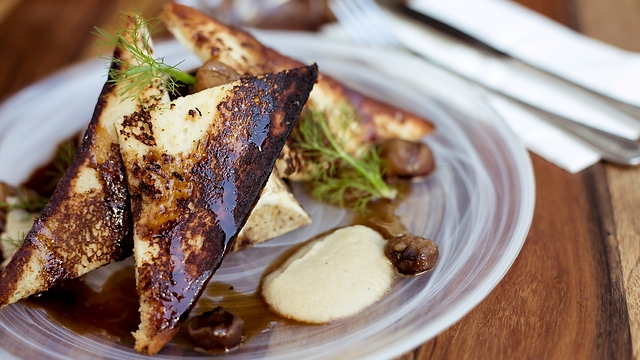
Brioche and steak
Dalida Restaurant in the Lewinsky Street Market( one of the lesser food markets in Tel Aviv) is that rare combination of a casual tavern with a chef who trained in a Michelin starred restaurant in France; the dominant cuisine is Arabic, with Italian, French and even Japanese influences
The unassuming exterior and rather funky interior is not what I had expected from a restaurant about whose food had created such a buzz, but it is easy to settle in and relax at Dalida. The young and friendly bilingual staff quickly bring a dish of nicely seasoned white fava beans to the table, with a carafe of water, lemon slices and menus in Hebrew and English for both food and alcohol.

Dalida has a satellite bar across the street, but the restaurant also has a well-stocked bar, which mixes eight specialty cocktails. Each house cocktail—like all drinks, including wine and beer—come in three sizes: glass, carafe and liter pitcher.

We ordered two of these cocktails: a Punch Berlin and a long margarita. The former blends white wine, vodka, and ginger ale with pieces of fresh fruit apple and pear and sprigs of mint. The drink needs to be left to steep for a while in order to be infused with the fruit, but it still tastes mostly of wine and mint.

The long margarita, meanwhile—tequila, orange liqueur and ginger ale, with a lemon wedge—is really no improvement over a classic margarita; nevertheless, both this and the Punch Berlin are refreshing drinks on a warm summer’s day or evening.


Dalia with its rather funky interior.

The food menu is divided into three categories of dishes by size: small, medium and large. In addition, there are seasonal specials that change every few months.

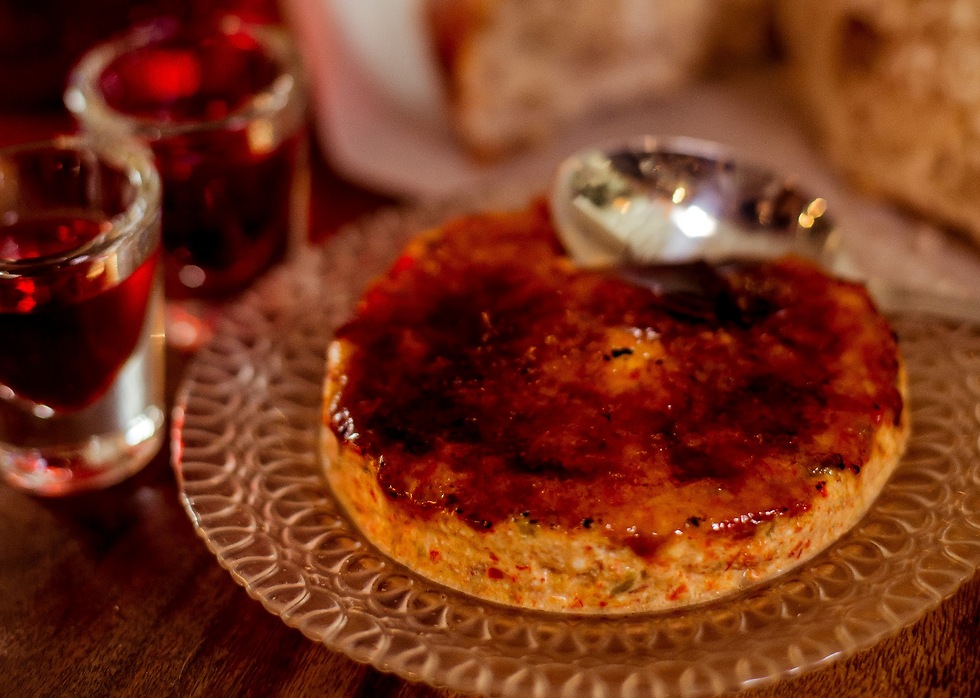
Our waitress recommended starting with one of Dalida’s most popular appetizers: spicy feta brûlée. This creation of Chef Dan Zoaretz is certainly inventive: salty white cheese turned pink from being seasoned generously with hot paprika, under a crust of burnt sugar. The zingy contrast of sweet with spicy is positively addictive, and reason enough for a return visit. Although this dish is in the small category, it is actually quite filling when spread on the accompanying half-loaf of crusty rustic bread.

Our second small plate was the lamb kebab: two tiny ground lamb patties in tehina with roasted white onion. The surprise ingredient here is pistachio; the succulent kebabs burst into flavor with each bite.

Our salad selection was the baked fennel with olives, dried cranberries, caraway and mint. dressed lightly with raw tehina. The fennel, which had been marinated in a confit of garlic and lemon, had a muted, mellow taste enhanced by the sweetness of the dried fruit. All in all, the dish, which was served on lafa, was distinctive and well-balanced.


Baked fennel with olives salad

Our waitress’s second recommendation of the evening was the brioche steak, which certainly sounded intriguing—not least because I like both brioche and steak. Except she forgot to explain that the steak refers not to beef but rather the especially thick slab of the soft bread. The disappointment did not last long, however, since the brioche was flanked by two bones filled with rich marrow and drenched in a beef and hibiscus stock. The gravy, while quite good, fortunately did not seep into the hollow of the bone or overwhelm the rich, succulent marrow. The superb dish was accented by a delicate Jerusalem artichoke cream, robust whole chestnuts, and an actual hibiscus flower.


Brioche and steak.

As the fresh fish of the day was trout, we chose that for our main course. Unusually, the filet was served in strips, alternated with roasted greens, king brown mushrooms, and caramelized carrots, as well as smears of kohlrabi cream and dabs of purslane and sorrel pesto. The pink fish, served at room temperature, was perfectly cooked and simply melted in the mouth. The sides added to the presentation, but not much to the flavor, which was fine: the fish needed nothing additional to improve on it, except maybe for the occasional dab of the herb pesto. You won’t find better than this even in a restaurant that specializes in fish and seafood.

Our main courses were washed down nicely with Dalida’s signature red sangria.

The six desserts on the menu presented us with some tough choices, which we whittled down to the cannoli and what looked to be a chocolate extravaganza.

The cannoli were filled with a mascarpone cream infused with Zacapa rum and served on an iced tropical fruit salad. The pastry wrapping was fortified with chia seeds, rendering it crisper, while the cream filling was heavenly.


Pepper creme brulee

The dessert named “I love chocolate” featured chocolate mousse encased in a chocolate shell atop a round almond financier, alongside a slew of other exotic ingredient, including cardamom caramel, pralines with the consistency of soft fudge, 70 percent chocolate brûlée—like mousse on steroids—salted pretzel nougatine and banana chips, all garnished with creme patissière. It is delicious fun playing with all these flavors and textures.

Dalida has some creative pricing policies, such as weekday cinq-à-sept hours when most dishes are half-price, and sharing menus for four to seven people. It is worth checking for occasional promotions as well—whatever makes it affordable to try this place at least once.

Dalida
7 Zevulun St., Tel Aviv
Tel. (03) 536-9627

Saturday, June 25, 2016

Yiddish versus Hebrew and Jewish Humour in Zion

Jews and Bars .... A Jew walks into a bar.... much like Hebrew versus Yiddish 


Sebastian James Henry Stevenson- Oakly-Halekile goes to watch Manchester United play Bacon on Friday from Hashemknowswhere on the Uconmenot Village in the County of  Stokely Isle.  , brink and you miss it, who have made it through to the FA Cup first round.draw and for the hell of it puts a a fifty   at 25,000 to one on Bacon and Friday to win. Given that the population of .Hashemknowswhere on the Uconmenot  village has just 14 males under 35, José Mário dos Santos Mourinho  field just the bench warmers of this 2nd  reserves squad. Old Trafford is filled to capacity as the United Faithfully expect a goal fiesta like none before it. The Bacon on Friday squad play their hearts out . Goalless until into 2 minute of stoppage time when they win a corner. Paddy Mechane steps up to take it.  Ball whistles  in and Paddy Joelcane walks on water and connects with a blind backward bicycle kick. The ball sails into the net and Bacon on Friday win the upset of the millenium.

Sebastian James Henry Stevenson- Oakly-Halekile cannot believe his luck . Collects his 1,250,000 quid in cash and walks into the nearest  bar overflowing with Manchester United supporters drowning their sorrows in beer and whisky chasers..    Sebastian James Henry Stevenson- Oakly-Halekile steps up to the bar and shoutsat the baman "Drinks are on the Me" but sees a couple both dresses in black at the end of the bar. He with ear locks dangling to his belly button, clutching a book with a Star of David with frilly threads dangling from holes in his white shirt. She in black from toe to neck and matching doekie  thing on her head and a  prominent Star of David around her neck.....Sebastian James Henry Stevenson- Oakly-Halekile, shouts again, "Drinks are on the Me except for those two Kikes at the end of the bar.". The bar goes wild and orders for a pint and  whiskey chasers come think and thin. from 209 in the bar who text and instagram friends and foe in nearby bars. They pound Sebastian James Henry Stevenson- Oakly-Halekile on the back and start singing his name . The Kike couple in the corner , beam and high five themselves  to Sebastian James Henry Stevenson- Oakly-Halekile puzzlement which pisses him off no end .  Sebastian James Henry Stevenson- Oakly-Halekile shouts again and again and again, "Another round for the House. drinks are on Me excepts for that godforsaken Kike couple " . The patrons have now grown to 3067 and orders are now a pint and a bottle of Highland 40 year Supreme chaser on the side .  Mrs Kike has now divested herself of everything black and i with flowing brown hair and just a Victoria Secrets pink slip and matching red bra and thong set , is doing the can can to the songs of praise that the patrons are singing to Sebastian James Henry Stevenson- Oakly-Halekile. with Mr. Kike accompanying them on the piano.  Sebastian James Henry Stevenson- Oakly-Halekile now down to his last pound turns to the barman and asks , "What the fxxk, why are the Kikes so happy to be excluded from my "Drinks are on me" repeatly?" ..... the Barman replies " Kikes ? Hey that is Mendel Dovid Chaim and Shoshana Chanya Ruthie Shabelowitz- Cohen.... they own the bar"
  .
Yiddish is a Germanic language, Hebrew is Semitic. That is the obvious difference.

Yiddish developed from High German that had two branches - German and Yiddish. Yiddish and German are somewhat similar but Yiddish even though it is Germanic throughout history had a lot of influence from Slavic languages and compared to German, a more loan words coming from them. It is the language that was and still is used by Ashkenazi Jews (Jews from Central and Eastern Europe). Yiddish generally has a lot in common with German and other Germanic languages and to some extent, Slavic languages as well. The only thing that makes people think that it is related to Hebrew is the fact that it is written in the Hebrew alphabet (or better to say abjad?).

Hebrew on the other hand belongs to the Semitic language family. It is closely related to Arabic and Amharic (though not completely intelligible with them). Hebrew was used mostly for liturgical purposes in history and Jews didn’t speak it. They mostly used Aramaic and various other languages (Ladino, Yiddish, Judeo-Arabic). Aramaic died out and since Jews were living in various places and when they started immigrating to Israel, they needed a language that will be common for them as they didn’t spoke the same language at that time (Jews from the Iberian peninsula spoke Ladino, Jews from North Africa and ME spoke various dialects of Arabic and Jews from Central and Eastern Europe spoke Yiddish). Hebrew was their ancestral language that was never actually spoken but since they thought of Israel as their ancestral land and Hebrew as their ancestral language, they revived it. As more and more Jews were immigrating to Israel, to avoid anti-Semitism, more and more children were born and they started learning Hebrew from a young age and thus becoming native speakers of it. That continued and a whole new generation of native speakers of Hebrew was created. It went from having 0 native speakers (and speakers in general) to having more than 8 milion today. It is the only known example of this kind of thing happening.

A great portion of Israeli Jews today are of Mizrahi-Sephardi/Ashkenazi descent. Hebrew is a common language for three groups - Mizrahi/Sephardi, Ashkenazi and Ethiopian Jews. While a lot of Ashkenazi Jews still speak Yiddish and are trying to keep the language alive, Hebrew is becoming more and more important because again, for most Jews, it is their ancestral language and the only common language between Jews of various backgrounds. Number of Yiddish speakers is increasing, especially in the Haredi community. Most Jews speak Hebrew today and Yiddish is the second language spoken by Jews when comparing number of native/L2 speakers. Other languages like Ladino or Judeo-Arabic are slowly dying out. Essentially, Yiddish is a language used primarily by Ashkenazi Jews while Hebrew is used by everyone - Mizrahi/Sephardi, Ashkenazi and Ethiopian Jews.


Two Jews Step into a Bar. One of them is leading a giraffe. They get drinks, and they feed drinks to the giraffe as well. The giraffe gets very drunk and passes out on the floor. The guy who brought him in steps over him on the way to the exit, and the second guy says, "Hey, you can't leave that lyin' there!" The first guy says, "It's not a lion, it's a giraffe."