Showing posts with label Tastes of Zion. Show all posts

Thursday, November 9, 2017

Sarah Kaplan Drus's Potato Kugal


The History of the Kugal 

Kugel (קוגל kugl, pronounced IPA: [ˈkʊɡl̩]) is a baked pudding or casserole, most commonly made from egg noodles(Lokshen kugel) or potato. It is a traditional Ashkenazi Jewish dish, often served on Shabbat and Yom Tov.

Etymology

The name of the dish comes from the Middle High German kugel meaning "sphere, globe, ball"; thus the Yiddish name likely originated as a reference to the round, puffed-up shape of the original dishes (compare to German Gugelhupf—a type of ring-shaped cake). Nowadays, however, kugels are often baked in square pans.

While Litvaks (Jews from Lithuania, northern Poland and northern Russia) call the pudding "kugel," Galitzianers (Jews from southeastern Poland and the western Ukraine) call it "kigel." 

History

The first kugels were made from bread and flour and were savory rather than sweet. About 800 years ago, cooks in Germany replaced bread mixtures with noodles or farfel.[3] Eventually eggs were incorporated. The addition of cottage cheese and milkcreated a custard-like consistency common in today's dessert dishes. In Poland, Jewish homemakers added raisins, cinnamonand sweet curd cheese to noodle kugel recipes. In the late 19th century, Jerusalemites combined caramelized sugar and black pepper in a noodle kugel known as "Yerushalmi kugel" or "Jerusalem kugel," which is a commonly served at Shabbat kiddushes and is a popular side dish served with cholent during Shabbat lunch.

In Romania, this dish is called Budinca de Macaroane/Paste Fainoase (Maccaroni/Pasta Pudding), and it is a traditional Romanian dish. In certain villages throughout the country it is known as "Baba Acolo". It is made with or without cheese, but it most always includes raisins.
Savory kugel may be based on potatoes, matzah, cabbage, carrots, zucchini, spinach or cheese.

A similar traditional Belarusian dish is potato babka.

In Lithuania, this dish is called Kugelis. It is baked potato pudding and it is a traditional Lithuanian dish. The main ingredients are potatoes, onions, and eggs. It may be spiced with salt, black pepper, bay leaves, and/or marjoram.
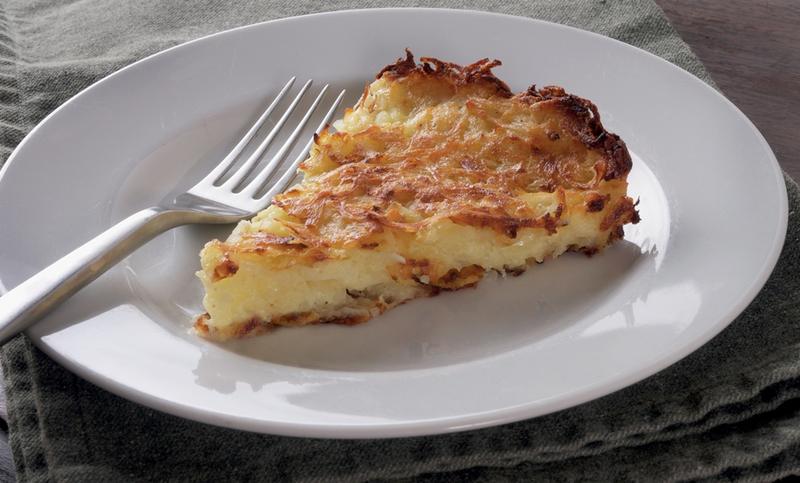


This is simply hash browns given amazing flavor and crispness from the schmaltz. Potato kugel is no different from latkes, except that schmaltz is added to the mixture here, whereas latkes are shaped into patties and then fried in schmaltz. (Potato kugel is considerably different from noodle kugel, which uses cheese and more eggs and is sweetened with sugar and spices.) The eggs allow you to call this a kugel, but it’s basically just a giant latke—every bit as tasty, twice as easy, and the cook can sit down with everyone else and eat it hot.

I shred potatoes by hand on a box grater because it’s faster than cleaning up the food processor, but feel free to use a processor fitted with the shredder blade.

I like to cook this kugel in a 12-inch/30-centimeter cast-iron skillet because it’s so convenient and makes a great serving vessel, but a baking dish will work perfectly fine. Leftovers can be reheated in a toaster oven; try serving leftovers with a poached egg on top!

Ingredients

1 large Spanish onion
3 large russet potatoes, peeled and submerged in cold water
1/2 cup/120 grams schmaltz
1 1/2 teaspoons kosher salt
1 1/2 teaspoons freshly ground black pepper
2 large eggs, beaten
2 tablespoons/15 grams matzo meal

Directions
Preheat the oven to 400°F/200°C.
  1. Grate the onion on the medium holes of a box grater. With your hands, squeeze out as much liquid as possible and put the onion in a large bowl. Grate the potatoes. After each potato, put the shreds in a kitchen towel and squeeze out as much liquid as possible, then toss it with the onion to prevent it from turning brown.
  2. Grease a large skillet or baking dish with a little schmaltz. Add the remaining schmaltz to the potato mixture and toss well.
  3. Add the salt and pepper to the eggs and beat them some more to distribute the seasoning. Add the eggs to the potatoes and onion and toss to thoroughly mix everything. Add the matzo meal and mix to incorporate. Transfer the mixture to the skillet or baking dish and smooth out the surface to make it level.
  4. Bake the kugel until it’s cooked through and golden brown and crisp on top, about 1 hour. This can be completed a half hour before you want to serve it and then reheated in the oven for 10 minutes before serving.
Serves 6 to 8.

Thursday, August 4, 2016

The Garden Terrace, The Waldorf Astoria Hotel, Gershon Agron St. 26, Jerusalem. Tel. (02) 542-3333.

Cocktails under the stars

The innovations continue at the award-winning Waldorf Astoria, as the Garden Terrace celebrated its grand opening. The lounge and promenade area transforms the rooftop of the restored historical section of the building that was once the eminent Palace Hotel into an ideal setting for relaxing with creative cocktails, gourmet tapas and even imported cigars.

The Garden Terrace basks in the cool air of Jerusalem’s evenings, above the bustle of the streets below and overlooking the eastern flank of Independence Park. The venue itself boasts its own greenery, creating an atmosphere of tranquility.


The Garden Terrace features a well-stocked bar with its own specialty cocktail menu and an internationally curated cigar collection. Additionally, the hotel’s Executive Chef Itzik Barak has designed a distinctive menu of Mediterranean-inspired tapas dishes to be enjoyed in this unique al fresco area.

The tapas here comprise a full range of vegetarian, meat and fish dishes, including veal spareribs, lamb kebab, ceviche, and a truly inspired upgrade of traditional meatballs, which are battered in a beer-infused tempura and served with pepper cream.


The Garden Terrace is the third restaurant to be located in the hotel, after The King’s Court (adjacent to the main lobby), and The Palace, dedicated to fine dining.

The restaurant is open Sunday-Thursday, from 18.00 to 23.00.

The Garden Terrace, The Waldorf Astoria Hotel, Gershon Agron St. 26, Jerusalem. Tel. (02) 542-3333.

Wednesday, August 3, 2016

Rama's Kitchen, Nataf, DN Jerusalem Hills 90804

The weird, glittery delicacy that grows in Mediterranean dunes
Chef Tomer Niv prepares exotic dishes made with the 
almost-forgotten ice plant, found in abundance near the Mediterranean shore.

The fleshy stalks of the plant that dots the rocky hills are covered with sparkling crystals. Their resemblance to icicles is reflected in the plant’s various popular names – common ice plant, crystalline ice plant or simply ice plant. The glistening “crystals” of Mesembryanthemum crystallinum are really water vesicles to which sea salt has adhered, and are part of a natural mechanism for ridding the plant of excess salt, as the plant’s natural habitat is a narrow, windblown area close to the Mediterranean.

An ice plant. Dan Peretz
“Some people grow this plant to use its leaves like spinach or as a green in a salad,” wrote Prof. Amotz Dafni in his book “Hadudaim Natnu Reham” (University of Haifa Press), a splendid collection of folklore and medicinal and nutritional uses for native plants. These days, the taste of this plant has been virtually forgotten, as its habitat has been shrinking to make way for new high-rises. But in recent weeks, ice plant has been featured in a number of dishes served by chef Tomer Niv at the Rama’s Kitchen restaurant in Nataf, in the Jerusalem hills. These include raw grouper sashimi surrounded by a shimmering crown of ice plant leaves; a tartare with loquats, green plums and ice plant stalks; blue crabs with cherry and ice plant gazpacho; salt-baked Jerusalem artichoke with whipped labaneh and ice plant.
It is early morning by the Jaffa harbor. Niv, taking his usual daily route from his home in the Ajami neighborhood to the fishermen’s warehouses by the ancient port, is horrified to discover that the day before, the city mowed the whole field of ice plants on a slope next to the luxury neighborhoods that have been sprouting up by the coastline. Just a couple of days ago, this slope was carpeted with the glittering plants. A tiny number of plants remain in a small corner of this area, once wild sand dunes that will apparently soon be transformed into a neat city park. Niv gets down on his knees and uses scissors to cut some fresh leaves and stems.

Jerusalem artichoke with whipped labaneh and ice plant. Dan Peretz
Enhancing fish 
and seafood
Niv first encountered this exotic plant, used in the kitchens of upscale restaurants in various countries, working in a French restaurant in London. “They would use it in dishes like beef fillet, but mainly it was used with lobster, scallops and fish,” he says. “One of the plant’s key characteristics is its ability to enhance the flavor of fish and seafood. It has a crunchy texture that adds to the experience when you’re eating a soft and tender fish, and its fresh salty, lemony flavor doesn’t overpower the flavor of the fish or seafood. When you eat it by itself, it’s kind of like tasting water with salt, and the crystallization of the salt is somewhat reminiscent of the taste of an oyster – that dull saltiness of the sea.”
Ice plant is in season from February to June. “Last year was the first time I noticed that it grows here,” says Niv. “So this year I was ready and waiting for it. It was nice to follow it through all the stages of its development and to taste the stalks, the leaves and the flower buds throughout the season. The stage we’re at now, just before the plant is covered with white flowers, is the tastiest, I think.”

Grouper sashimi with ice plant leaves. Dan Peretz
Niv picks some wild chrysanthemums to add to his basket. “I think wildflowers have gotten a bad rap lately, because of their overuse by local cooks and chefs, but the taste of flowers that grow in nature is quite different than domesticated plants grown in greenhouses. Each one has a distinctive flavor or texture and they are not just for garnish.” Niv studied cooking and food technology in London and worked for a year in the famous laboratory of British chef Heston Blumenthal. He dreams of starting his own laboratory, like the one established by chef Rene Redzepi of the Noma restaurant in Copenhagen, which methodically examines ingredients in Nordic cuisines. Niv’s lab would study ingredients native to this area and those used in Mediterranean cuisine.

Rama's Kitchen, Nataf, DN Jerusalem Hills 90804

The weird, glittery delicacy that grows in Mediterranean dunes
Chef Tomer Niv prepares exotic dishes made with the 
almost-forgotten ice plant, found in abundance near the Mediterranean shore.

The fleshy stalks of the plant that dots the rocky hills are covered with sparkling crystals. Their resemblance to icicles is reflected in the plant’s various popular names – common ice plant, crystalline ice plant or simply ice plant. The glistening “crystals” of Mesembryanthemum crystallinum are really water vesicles to which sea salt has adhered, and are part of a natural mechanism for ridding the plant of excess salt, as the plant’s natural habitat is a narrow, windblown area close to the Mediterranean.

An ice plant. Dan Peretz
“Some people grow this plant to use its leaves like spinach or as a green in a salad,” wrote Prof. Amotz Dafni in his book “Hadudaim Natnu Reham” (University of Haifa Press), a splendid collection of folklore and medicinal and nutritional uses for native plants. These days, the taste of this plant has been virtually forgotten, as its habitat has been shrinking to make way for new high-rises. But in recent weeks, ice plant has been featured in a number of dishes served by chef Tomer Niv at the Rama’s Kitchen restaurant in Nataf, in the Jerusalem hills. These include raw grouper sashimi surrounded by a shimmering crown of ice plant leaves; a tartare with loquats, green plums and ice plant stalks; blue crabs with cherry and ice plant gazpacho; salt-baked Jerusalem artichoke with whipped labaneh and ice plant.
It is early morning by the Jaffa harbor. Niv, taking his usual daily route from his home in the Ajami neighborhood to the fishermen’s warehouses by the ancient port, is horrified to discover that the day before, the city mowed the whole field of ice plants on a slope next to the luxury neighborhoods that have been sprouting up by the coastline. Just a couple of days ago, this slope was carpeted with the glittering plants. A tiny number of plants remain in a small corner of this area, once wild sand dunes that will apparently soon be transformed into a neat city park. Niv gets down on his knees and uses scissors to cut some fresh leaves and stems.

Jerusalem artichoke with whipped labaneh and ice plant. Dan Peretz
Enhancing fish 
and seafood
Niv first encountered this exotic plant, used in the kitchens of upscale restaurants in various countries, working in a French restaurant in London. “They would use it in dishes like beef fillet, but mainly it was used with lobster, scallops and fish,” he says. “One of the plant’s key characteristics is its ability to enhance the flavor of fish and seafood. It has a crunchy texture that adds to the experience when you’re eating a soft and tender fish, and its fresh salty, lemony flavor doesn’t overpower the flavor of the fish or seafood. When you eat it by itself, it’s kind of like tasting water with salt, and the crystallization of the salt is somewhat reminiscent of the taste of an oyster – that dull saltiness of the sea.”
Ice plant is in season from February to June. “Last year was the first time I noticed that it grows here,” says Niv. “So this year I was ready and waiting for it. It was nice to follow it through all the stages of its development and to taste the stalks, the leaves and the flower buds throughout the season. The stage we’re at now, just before the plant is covered with white flowers, is the tastiest, I think.”

Grouper sashimi with ice plant leaves. Dan Peretz
Niv picks some wild chrysanthemums to add to his basket. “I think wildflowers have gotten a bad rap lately, because of their overuse by local cooks and chefs, but the taste of flowers that grow in nature is quite different than domesticated plants grown in greenhouses. Each one has a distinctive flavor or texture and they are not just for garnish.” Niv studied cooking and food technology in London and worked for a year in the famous laboratory of British chef Heston Blumenthal. He dreams of starting his own laboratory, like the one established by chef Rene Redzepi of the Noma restaurant in Copenhagen, which methodically examines ingredients in Nordic cuisines. Niv’s lab would study ingredients native to this area and those used in Mediterranean cuisine.

Sunday, July 17, 2016

Miss Kaplan: Evangelist Vega Restaurant, Templar Building Sarona Market,


Miss Kaplan
Miss Kaplan. (photo credit:PR)
Share on Facebook Share on Twitter
The story of vegan restaurant Miss Kaplan starts with the story of Ori Shavit, a food journalist who underwent a transformation and not only became a vegan herself but has become an evangelist for veganism in Israel, which now has the world’s largest vegan population per capita – reportedly five percent of the country’s population. As part of her outreach campaign, Shavit has launched the organization Vegans on Top and opened Miss Kaplan, dedicated to the proposition that vegan food can be as tasty and popular to the restaurant-going public as any other cuisine.

If Shavit’s mission is to make the food so good that no one would feel it is a sacrifice to be vegan, I was eager to put Miss Kaplan to the test. The restaurant is situated on the edge of the Sarona Market complex, on the second floor of an old Templer building. There is no elevator, but there are two al fresco tables downstairs. Indoors, it is a small, cozy place, with the original tile floors and a funky vibe, thanks to Shavit’s decision to leave the walls in their chipped and peeling condition. A tree right outside the window and hanging plants inside impart a touch of nature.
The atmosphere may appear informal, but the wait staff is very professional. The waitresses are knowledgeable, even dispensing tips on how to eat each dish. The new English menus were at the printer’s when I was there, but it exists online. Dishes are itemized in two categories – cold and hot. Dishes that are available gluten-free are marked “GF.”

A complimentary snack of fried garbanzo beans was served upon seating. Perfectly seasoned, the little morsels were addictive.

Clearly, alcohol is an approved vegan ingredient. There were six rather elaborate specialty cocktails. The waitress recommended the Green Detox Smash (NIS 48) as a drink that goes well with food. This blend of gin, celery-apple syrup, Kaffir lime leaves, lemongrass and lime, garnished with a sprig of mint, was very refreshing, with a little bite.

Also excellent was the more complex Jamaican Delight (NIS 48) – tequila infused with fresh curry leaves, Jamaican spices, mango, Aperol, habanero extract and fresh lime. Served in a salt-rimmed glass, the cocktail had a fresh aftertaste.

As I waited for my first course, I sampled the house bread (NIS 14). The thick slices of crusty, soft, spelt bread were accompanied by a carrot jam seasoned with cilantro seeds and white balsamic vinegar. The jam was lip-smacking, leaving a pleasant tingle of heat in the mouth.

The potato carpaccio (NIS 42) was thinly sliced squares of potato loaded with baby fennel confit, Tassos olives, herbs and watercress in a sherry aioli. The mellow fennel with the salty olives topped with crispy discs of fried potato delivered a wonderful interplay of flavors and textures. The dish was garnished with slices of fiery red chili pepper, but the aioli containing Dijon mustard really packed a punch.
The smoked carrot sausage (NIS 48) may be Miss Kaplan’s signature dish. Carrots were brushed liberally with Jack Daniels bourbon and applewood-smoked to the consistency of a sausage. The dish may consist of one carrot the thickness of a bratwurst or two carrots resembling frankfurters, served on a steamed bun with lettuce and pickled onion. The whiskey and smoking process imparted a flavor that evoked barbecue. Given what passes as fast food hot dog in this country, I would take this magnificent version every time.

The smoked beet (NIS 48) may be named after the dominant ingredient, but the main ingredient in terms of quantity were the crispy wedges of fried fingerling potatoes upon which were piled small mounds of miniature cubes of smoked beet. Another interesting role was played by dollops of an exotic espresso aioli, along with dabs of beet ketchup. This dish was as delicious as it was inventive.

Another creative dish was the Kabocha squash, aka Japanese pumpkin (NIS 68). Large slices of caramelized squash atop a puree of pumpkin and shallots surrounded water spinach cooked in a sauce of chili, ginger and lemongrass. The flavorful green vegetable and the sweet candied pumpkin, both sprinkled with ginger dust, may be enjoyed separately or together.

Only two desserts were available, although I was told more are coming. The espresso banana bread (NIS 39) – a small piece of cake on a chocolate espresso sauce, along with cubes of fresh banana and cocoa crumble – was a nice finale to a memorable meal.

There was not a moment during the meal where I felt anything was lacking because of the restrictions of veganism. On the contrary, I was feeling downright virtuous throughout. If Miss Shavit founded Miss Kaplan to prove that being vegan is not necessarily a sacrifice, then I can only say: Mission accomplished.


Miss Kaplan
Vegan ( no kashrut certificate)
Sarona Market
18 Eliezer Kaplan Street
Tel Aviv
Tel 03-6979015

Miss Kaplan: Evangelist Vega Restaurant, Templar Building Sarona Market,


Miss Kaplan
Miss Kaplan. (photo credit:PR)
Share on Facebook Share on Twitter
The story of vegan restaurant Miss Kaplan starts with the story of Ori Shavit, a food journalist who underwent a transformation and not only became a vegan herself but has become an evangelist for veganism in Israel, which now has the world’s largest vegan population per capita – reportedly five percent of the country’s population. As part of her outreach campaign, Shavit has launched the organization Vegans on Top and opened Miss Kaplan, dedicated to the proposition that vegan food can be as tasty and popular to the restaurant-going public as any other cuisine.

If Shavit’s mission is to make the food so good that no one would feel it is a sacrifice to be vegan, I was eager to put Miss Kaplan to the test. The restaurant is situated on the edge of the Sarona Market complex, on the second floor of an old Templer building. There is no elevator, but there are two al fresco tables downstairs. Indoors, it is a small, cozy place, with the original tile floors and a funky vibe, thanks to Shavit’s decision to leave the walls in their chipped and peeling condition. A tree right outside the window and hanging plants inside impart a touch of nature.
The atmosphere may appear informal, but the wait staff is very professional. The waitresses are knowledgeable, even dispensing tips on how to eat each dish. The new English menus were at the printer’s when I was there, but it exists online. Dishes are itemized in two categories – cold and hot. Dishes that are available gluten-free are marked “GF.”

A complimentary snack of fried garbanzo beans was served upon seating. Perfectly seasoned, the little morsels were addictive.

Clearly, alcohol is an approved vegan ingredient. There were six rather elaborate specialty cocktails. The waitress recommended the Green Detox Smash (NIS 48) as a drink that goes well with food. This blend of gin, celery-apple syrup, Kaffir lime leaves, lemongrass and lime, garnished with a sprig of mint, was very refreshing, with a little bite.

Also excellent was the more complex Jamaican Delight (NIS 48) – tequila infused with fresh curry leaves, Jamaican spices, mango, Aperol, habanero extract and fresh lime. Served in a salt-rimmed glass, the cocktail had a fresh aftertaste.

As I waited for my first course, I sampled the house bread (NIS 14). The thick slices of crusty, soft, spelt bread were accompanied by a carrot jam seasoned with cilantro seeds and white balsamic vinegar. The jam was lip-smacking, leaving a pleasant tingle of heat in the mouth.

The potato carpaccio (NIS 42) was thinly sliced squares of potato loaded with baby fennel confit, Tassos olives, herbs and watercress in a sherry aioli. The mellow fennel with the salty olives topped with crispy discs of fried potato delivered a wonderful interplay of flavors and textures. The dish was garnished with slices of fiery red chili pepper, but the aioli containing Dijon mustard really packed a punch.
The smoked carrot sausage (NIS 48) may be Miss Kaplan’s signature dish. Carrots were brushed liberally with Jack Daniels bourbon and applewood-smoked to the consistency of a sausage. The dish may consist of one carrot the thickness of a bratwurst or two carrots resembling frankfurters, served on a steamed bun with lettuce and pickled onion. The whiskey and smoking process imparted a flavor that evoked barbecue. Given what passes as fast food hot dog in this country, I would take this magnificent version every time.

The smoked beet (NIS 48) may be named after the dominant ingredient, but the main ingredient in terms of quantity were the crispy wedges of fried fingerling potatoes upon which were piled small mounds of miniature cubes of smoked beet. Another interesting role was played by dollops of an exotic espresso aioli, along with dabs of beet ketchup. This dish was as delicious as it was inventive.

Another creative dish was the Kabocha squash, aka Japanese pumpkin (NIS 68). Large slices of caramelized squash atop a puree of pumpkin and shallots surrounded water spinach cooked in a sauce of chili, ginger and lemongrass. The flavorful green vegetable and the sweet candied pumpkin, both sprinkled with ginger dust, may be enjoyed separately or together.

Only two desserts were available, although I was told more are coming. The espresso banana bread (NIS 39) – a small piece of cake on a chocolate espresso sauce, along with cubes of fresh banana and cocoa crumble – was a nice finale to a memorable meal.

There was not a moment during the meal where I felt anything was lacking because of the restrictions of veganism. On the contrary, I was feeling downright virtuous throughout. If Miss Shavit founded Miss Kaplan to prove that being vegan is not necessarily a sacrifice, then I can only say: Mission accomplished.


Miss Kaplan
Vegan ( no kashrut certificate)
Sarona Market
18 Eliezer Kaplan Street
Tel Aviv
Tel 03-6979015

Friday, May 13, 2016

From France to Chile to Tokyo to Zion: The Boom of Kosher Restaurants Worldwide


Kosher restaurant app founder says more food establishments recognize value of adding kosher products to their range, while anti-Semitism leads many Jews to move away and kosher restaurants to close.

For those travelling who observe Kashrut (Jewish dietary laws), New York is the easiest place to visit, as the largest concentration outside of Israel of kosher restaurants and food establishments in the world is in the Big Apple, according to the app “Kosher Near Me,” which centralizes information about kosher restaurants and products across the world.

According to Jonathon Myron, the founder of the free mobile app, the precise number of kosher restaurants in the world is constantly changing due to the rapid turnover of openings and closures. The most recent numbers, however, indicate that there are between 3,500-4,000 kosher restaurants in the world, at least 800 of which are located in New York alone.
 
Notwithstanding North America, France boasts the largest concentration of kosher restaurants as well as, incidentally, the largest Jewish population in Europe. France leads considerably against the other countries on the continent with 300 kosher restaurants alone compared to 700 throughout Europe.
 Click to view next picture
Avi Cohen has always dreamed of owning an upscale restaurant that serves nothing but the best ingredients. His dream came true in December 2013, with his La Brochette steakhouse becoming the latest addition to Manhattan’s fine dining scene. The name “La Brochette” which means “skewer” in French, gracefully combines the owner’s Middle Eastern roots with French culinary sophistication. La Brochette undertook mulit-million renovations of the space formerly occupied by another kosher restaurant on Midtown's East side, where upscale kosher restaurants are hard to come by. The elegant restaurant boasts 5 dining rooms on 3 levels with the top floor featuring a skylight. Although the restaurant is large, the setting is intimate. The neutrally-hued décor features chandeliers and candle-lit mahogany tables, yet the streamlined design has a contemporary feel to it. - See more at: 

“Despite the changes, the migration, and the existing problems for the Jewish community, there is still a massive number of restaurants and demand for kosher food, and the best option for those who keep Kashrut is in Paris and outside it,” said Myron.

What is the most surprising place for kosher restaurants in the world?

“We were really surprised when restaurant were added to our list with names such as 'Kosher Pita Grill' which opened in Guayaquil in Ecuador. There is a small community there of around 1,000 Jews but they have been going through a kind of renaissance in recent years,” Myron said. “They came together to open up the only kosher restaurant in the city. We think this is magnificent.”

Other places where one may not expect to find kosher food (other than in Chabad houses) include: a falafel place in Tokyo, a brasserie in Luxembourg, Cafe Hillel in Caracas, Kosher Center in the city of San Jose in Costa Rica and Cafe Eden in Istanbul. Moreover, there are no less than six kosher restaurants in Chile.
 cafe-eden-kosher
 Caffe Eden opens in Ortakoy. The restaurant’s menu includes kosher meat dishes and burgers as well as popular Turkish dishes such as doner, lahmacun and pide.The meat served at the new restaurant comes from special production facilities which are inspected, strictly. The animals are slaughtered by Schochet according to Sehita rules and delivered to the restaurant after all inspections including hygiene are thoroughly completed. Caffe Eden’s kitchen and food are constantly inspected by a full time inspector. The restaurant adds new dishes to its menu every week. 

The question of Kashrut remains an issue for Israelis who observe the dietary laws during their travels abroad. Indeed, Myron highlights the fact that levels of observance differ even between observant Jerusalem diners and those throughout the rest of the country.

While the capital is teeming with kosher restaurants - the number is other areas in Israel the is lower and sometimes significantly so.

Are we are living in an era in which the popularity of kosher establishments across the world is at its peak? It appears so. While many Jews observe varying levels of the rules of Kashrut, many people across the world choose to consume kosher products since the kosher stamp is believed to reflect superior standards of supervision and health-related monitoring.

Unprecedented boom
It is estimated that the kosher industry rakes in an annual profit of $13 billion, a figure that plays heavily in the considerations of food producers and food establishments.

According to Rachel Orian of the Kosher Delight Magazine, “more and more chefs in the world search for kosher additions to their selections because they realize that it is good for business. It brings in a quality customer base and opens up more options.” She went on to say that “many companies apply for kosher certification for their products. There is no doubt that the kosher market is booming.”

Myron agrees that kosher industry is undergoing an unprecedented growth. “A lot of options have opened up as a result of social networks that enable the quick transfer of information about kosher products and restaurants with a high degree of reliability for customers,” he said.

“Also, food suppliers and those who oversee the production of food and supply the kosher certificate see to it that the information makes it to the local community and to tourists so that everyone can easily check which kosher products or restaurants are in their area,” Myron added.

Are there countries in which kosher food has become more common and others where, with time, it has become more and more difficult to find kosher products?

According to Myron, “The Jewish people are in perpetual movement. In the US, for example, there is a number of restaurants that are closing down in cities in the Midwest because the population is moving away. By contrast, kosher businesses are flourishing on the west and east coasts, where the Jewish community has grown, in places such as Miami or Las Vegas. In those places, the kosher market is becoming significantly strong.”

The next stage: Gourmet Kosher restaurants
Orian believes that a direct correlation exists between kosher businesses and anti-Semitism: “In countries where anti-Semitism in increasing, Jews are leaving and the kosher restaurants are closing.”

She also points to relocation as an additional reason for the transformation of the kosher landscape: “In specific cities in the US, the older generation is passing away while the new generation is moving away, which is another reason why kosher businesses are decreasing. There are communities where there are practically no kosher restaurants in the city, but they still place importance on having a kosher kitchen in community buildings or synagogues, even in Conservative or Reform communities.”

Myron’s app, which was launched in 2011, has been downloaded by more than 100,000 users and allows them to find kosher products or restaurants in cities all over the world.

Is it easier today for tourists to observe Kashrut than it was a decade ago?

“There are, undoubtedly, more options available today than in the past. Even in the more remote areas where there isn't a particularly large Jewish community, it's normally possible to find kosher products in supermarkets or use the help of members of the Chabad movement or other organizations. Tourists are, more and more, able to purchase ready-made or packaged food that they can take away.”

Orian further points out that there are also places where it's possible to order Shabbat meals in advance and receive it on Friday afternoon.

So what's next?

“We are seeing more and more places opening restaurants not only to supply basic kosher goods but also to take the project to the next step - kosher gourmet food. There are many restaurants that bring in renowned chefs and invest significant sums of money to offer diners a richer experience, while the kosherinternational award-winning wines provide another quality aspect to the market,” concluded Myron