Stephen Darori- Tastes of Zion: One People Many Tastes.(#TastesFromZion)
Food, Restaurants and Family Recipes
from Israel and the Middle East.
Stephen Darori,is a Poet (#BardOfBatYam),(PoetLaureateOfZion) , Gourmet and Cat Lover,Cooks for one and
eats for five and has a few to many extra pounds to show for his culinary love and excellence.
Follow Stephen Darori on Twitter, Linkedin and Facebook.
Showing posts with label Just a Rip Roaring Zionist. Show all posts
Showing posts with label Just a Rip Roaring Zionist. Show all posts
Ingredients 1 shoulder of lamb, about 1.6 - 1.8 kg (3.5 - 4 lbs) Sea salt and black pepper
Marinade 4 garlic cloves, crushed to a paste with a pinch of salt Juice of 1/2 lemon 2 tablespoons red wine vinegar 1/2 medium red onion, finely grated 2 teaspoons sweet paprika 1 tablespoon olive oil
To serve: 1 quantity Chickpea Puree (see below) 1 quantity Hot Mint Sauce (see below)
Place the lamb in a large roasting pan. If you are using a shoulder, score the surface very lightly 1-2mm deep in a 1 cm criss-cross pattern to help the marinade penetrate the meat.
Mix all the marinade ingredients together except the olive oil, season with salt and pepper, and rub all over the meat. Now add the olive oil (it can prevent the acidity of the lemon and vinegar from penetrating the meat), and leave to marinate for a minimum of 2 hours, turning occasionally, or in the fridge overnight.
Preheat the oven to 160C (325F). Cook the lamb for a minimum of 3 hours, adding a small glass of water (125ml or 1/2 cup) to the pan after the first 30 minutes and each subsequent hour. Baste the lamb every 45 minutes. To test if the lamb is ready, insert a wooden skewer in the centre: if the meat is soft and has a lot of give, then it is done. Let it rest for 15 minutes before carving.
Chickpea Puree
Makes 6 servings
Ingredients
1 teaspoon cumin seeds
3/4 cup extra-virgin olive oil, divided
3 large garlic cloves, minced
3 cups drained canned chickpeas (garbanzo beans; from about three 15-ounce cans), liquid reserved
1 teaspoon coarse kosher salt
1/2 teaspoon paprika
1/8 teaspoon cayenne pepper
Preparation
Stir cumin in dry skillet over medium heat until lightly toasted, about 2 minutes.
Transfer to mortar or spice mill; grind.
Heat 1/4 cup oil in large saucepan over medium-high heat.
Add garlic and cumin; stir 1 minute.
Add chickpeas, 1 teaspoon coarse salt, paprika, and cayenne; sauté until chickpeas begin to darken, about 5 minutes.
Pour chickpea liquid into 2-cup measuring cup; add enough water (if necessary) to measure 2 cups.
Add liquid to chickpea mixture; bring to boil. Reduce heat to medium; simmer until chickpeas begin to soften, stirring often, about 10 minutes.
Pour chickpea mixture into strainer set over bowl; reserve cooking liquid.
Transfer chickpeas to processor; add 3/4 cup of reserved cooking liquid.
Add 1/2 cup oil; puree until smooth. Season with salt and pepper. Cool.
Do ahead Can be made 1 day ahead.
Cover; chill. Bring to room temperature before using.
Real mint sauce recipe
Preparation time
less than 30 mins
Cooking time
no cooking required
Serves 4
Mint grows so freely that once you know the trick you never need buy mint sauce again.
Ingredients
bunch of mint pinch salt 4 tbsp boiling water 4 tbsp white wine vinegar 1 level tbsp caster sugar
Method
Strip off the mint leaves, sprinkle with salt and chop finely.
Place into a jug, add the sugar and pour over the boiling water, stir and leave to cool.
Stir in the vinegar and taste.
Add more water or vinegar and adjust seasoning to suit your taste.
Lamb with Chickpea Puree and Hot Mint Sauce
Serving Size: 4 to 6
1 shoulder of lamb, about 1.6 - 1.8 kg (3.5 - 4 lbs)
Sea salt and black pepper
Marinade
4 garlic cloves, crushed to a paste with a pinch of salt
Juice of 1/2 lemon
2 tablespoons red wine vinegar
4 tablespoons fresh thyme leaves
1/2 medium red onion, finely grated
2 teaspoons sweet paprika
1 tablespoon olive oil
To serve:
1 quantity Chickpea Puree (see below)
1 quantity Hot Mint Sauce (see below)
Place the lamb in a large roasting pan. If you are using a shoulder, score the surface very lightly 1-2mm deep in a 1 cm criss-cross pattern to help the marinade penetrate the meat.
Mix all the marinade ingredients together except the olive oil, season with salt and pepper, and rub all over the meat. Now add the olive oil (it can prevent the acidity of the lemon and vinegar from penetrating the meat), and leave to marinate for a minimum of 2 hours, turning occasionally, or in the fridge overnight.
Preheat the oven to 160C (325F). Cook the lamb for a minimum of 3 hours, adding a small glass of water (125ml or 1/2 cup) to the pan after the first 30 minutes and each subsequent hour. Baste the lamb every 45 minutes. To test if the lamb is ready, insert a wooden skewer in the centre: if the meat is soft and has a lot of give, then it is done. Let it rest for 15 minutes before carving.
There’s a Yiddish expression to describe something that has no value: “an etrog after Sukkot.” Considering that an etrog can cost $30 or more before Sukkot—the holiday in which this citrus fruit is ritually important—and yet seems to be worth nothing once the holiday ends, it’s an apt expression.
So, what can you do with an etrog after Sukkot? It would be wasteful as well as disrespectful to simply toss this exotic fruit in the garbage—especially when there are, in fact, many uses for it.
There is a rich folklore of Jewish customs concerning the post-holiday etrog. Traditionally, once it was retired from its ritual role, the etrog was turned over to women for secular uses. In The Jewish Holidays: A Guide and Commentary, Michael Strassfeld notes that the fruit, with its breastlike shape, was considered to have a special relationship to women, and a variety of Old World practices connected it to pregnancy and birth. A childless woman who wanted to bear a son was advised to bite the pitom (tip) of an etrog. A pregnant woman who ate the etrog after Sukkot, according to the Talmud, would give birth to a “fragrant” child—the equivalent of a “good” child. And a woman in labor could ease the pain of childbirth, it was said, by placing the etrog’s pitom under her pillow.
The belief that the etrog could ease the pains of childbirth also extended to jam or jelly made from the fruit. My bobba , Sarah Kaplan Drus who immigrated to the South Africa from Krakow in Poland, soaked etrog peel for days to decrease its bitterness and made it into marmalade, saving the precious jars of golden preserves to give postpartum mothers, including my own mother, to help them recover their strength after childbirth.
There are other classic ways of preserving etrog, or citron, that have less to do with folk wisdom and more to do with traditional uses of citrus fruits in general. The etrog can lend itself to a number of drinks. After Sukkot, John Kirkpatrick, an etrog-farmer in California, sells great quantities of the remaining fruit, as well as a related citron called Buddha’s Hand, to St. George Spirits for its citron-infused vodka. In Italy, a liqueur described as “the noble cousin of limoncello” is made with the rind of citron rather than lemon; Zaida Reuven, a Dallas supplier of etrog-and-lulav sets and author of The Esrog, calls such a liqueur “etrog schnapps” and provides a simplerecipe. The citron peel could also be used to flavor other beverages, such as lemonade or sangria.
Remember, Jews aren’t the only people who use the etrog: Candied citron, in particular, has a long non-Jewish history. Since the 15th century, when citron peels were soaked in seawater brine for 40 days before being submerged in a sugar solution, it has been a signature flavor of Christmas cakes such as Italian panettoneand English fruitcake. David Lebovitz, a pastry chef and cookbook author who lives in Paris, has experimented with making candied and glazed citrons. (As with all culinary uses of the etrog, it’s always a good idea to wash and scrub the peel to reduce any pesticide residue.)
Candied citron and citron preserves are fundamental to pastry making in Sicily, where the etrog (cedro, in Italian) is grown and sold. Tourists, seeing these giant citrons for sale alongside lemons and oranges at fruit stands, often remark that these are the largest lemons they’ve ever seen. But if they buy one expecting to find abundant juice, they soon realize their mistake: The pulp of the etrog is seedy and dry. The pith, however—that white spongy layer beneath the peel that is often bitter in lemons and oranges—is a wide expanse in an etrog and can be surprisingly sweet. Sicilians cut the pith into thin slices and sprinkle them with salt or sugar for a snack, or combine them in a salad with fennel, oil, salt, and pepper.
Ancient Greeks and Romans also ate etrog pith in salads, but in the ancient world the fruit’s most renowned quality—and likely what inspired Hindus and Buddhists, as well as Jews, to adopt it as a religious symbol—was what Theophrastus, the Greek philosopher and father of botany, described as its “exquisite odor.” Citron oil (“possessed of the most wonderful properties,” as one botanist wrote) became a sought-after luxury, the fragrance of royalty and affluence. In Roman times, when citrons adorned bridal chambers, it was also a perfume believed to inspire love. Botanists in antiquity offered a number of labor-intensive methods to extract the oil. One instructed the collector to rub cotton wool saturated in sesame oil onto the fruit as it grew, three times a day for 40 days. After these 120 rubbings, the perfumer picked the etrog and gently scraped the oil from the rind with a small silver spoon. Clearly the fragrance of etrog was thought to be worth such painstaking labor.
It’s far easier to make your own version of etrog-scented oil simply by infusing oil with the zest. Grate the peel of a cleaned etrog and put it in a small glass bottle so it fills half the bottle, then add almond oil, light olive oil, or another oil to the top. Set the bottle in a sunny place for a few days, shaking it a few times every day, then store at room temperature. Add a few drops of this scented oil to a bath, or fill a spray bottle with water and a few drops of the etrog oil for a pleasant air freshener.
Another way to employ the etrog’s lovely fragrance is to pierce the skin of the fruit and fill the holes with dried cloves, covering the etrog completely. As the etrog dries, it releases a wonderful scent and the whole fruit may be used as a “spice box” for the Havdalah ceremony to mark the end of the Sabbath.
If you have a green thumb, you may want to try growing your own etrog tree from seed. Remove the seeds from your etrog, wash them, and plant them in a well-drained potting mix. Keep the plants warm and moist, and repot when necessary. If you are patient and care for your citrus plant well, in about four or five years you may have your own home-grown etrog to use on Sukkot—and after the holiday ends.
If you’ve never made challah before, this is your chance. And we want to see your pictures when you make it!
This challah recipe uses the same dough as our previous challah recipe (the famous cinnamon roll challah) but with a different filling. However, this time we let the dough rise a second time and a gave it a second eggwash before baking. This makes sure it stays together during baking- so no leaky filling. *** Pro tip: check out the round braid. It’s easier than it looks. Go for it!
Ingredients (1 challah)
Dough- 2 teaspoons dry yeast 1 teaspoon honey 2/3 cup warm water 3 tablespoons honey 1/3 cup olive oil 1 teaspoon salt 2 eggs (and another 1 for egg wash) 4 cups flour
Filling- halva chocolate chips
Directions:
First you need to activate the yeast. Whisk the yeast with 1 teaspoon of honey and warm water and wait a few minutes until it looks foamy.
Add 3 tablespoons of honey, the olive oil, salt and eggs. Mix with a wooden spoon and gradually add in the flour. When the dough forms into a ball, knead for 5 minutes. Cover the dough and let it rise for 1 hour.
When the dough has doubled in size, separate it into 4 equal parts. Shape each part into a ball, and roll into a circle. Sprinkle the halva and chocolate chips onto each of the 4 circles and roll into a long rope. Stretch the ropes as long as you can and braid. Pinch the ends. Now for braiding. You can follow the pictures below or watch the video to learn the braid.
Step 1: set the four braids like in the picture below. Fold the ends of the ropes over each other.
step 2: now the remaining 3 sides
Step 3: now we fold the ropes from 2 different sides like below
Step 4: Squeeze the two ends together
Step 5: Tuck below
Brush the braided dough with egg wash (which is just a beaten egg) and let rest for 1 hour. Preheat oven to 375 °F or 190 °C.
Brush with egg wash again and sprinkle halva crumbs on top. Bake for 30 minutes. If the top begins to brown too quickly you can cover it with foil. Shabbat shalom!
This Tabbouleh Salad With Cauliflower Rice Is Heaven In A Bowl
The key to amazing tabbouleh salad is in the parsley.
Video:
INGREDIENTS (Serves 4)
1/2 small cauliflower
2 cups of flat-leaf parsley, finely chopped (approx 3 bunches)
1/2 cup of mint, finely chopped
1 Persian cucumber, chopped (the normal kind in Israel)
1 cup cherry tomatoes, quartered
1/2 small white onion, chopped
1/4 cup quality olive oil
3 tbsp. lemon juice
1/2 tsp. salt
1/4 tsp. black pepper
1/4 tsp. cumin
PREPARATION
For the cauliflower rice:
1. Cut the cauliflower in half. Cut out the hard core. Cut into pieces that fit in the food processor.
2. Place pieces in food processor. Pulse about 5 times or until pieces are the size of rice. You can also use a hand grater for this step.
3. Transfer the cauliflower rice to a microwavable bowl. Microwave for 2 1/2 mins. This leaves the cauliflower rice with a little crunch- which we love for tabbouleh salad! If you want the cauliflower rice to taste more like actual rice, microwave for 3 minutes.
For the salad:
Literally just add everything to a bowl and mix. But there are a couple important tips if you want a more authentic tabbouleh salad:
Tabbouleh tip #1: It’s all about the parsley. Parsley should be the main ingredient in the salad- get some fresh parsley!
Tabbouleh tip #2: Make sure the parsley and mint are dry before adding to the salad. Use paper towels or a spin dryer thing. Any extra water in the salad is bad.
2. Boil egg noodles in salted water for 5-7 mins until al-dente. Strain.
3. Meanwhile, in a large mixing bowl, add the eggs and sugar. Mix well then add the melted butter, cream cheese, cottage cheese, vanilla extract and golden raisins. Mix and mash with a fork until all the pieces are broken up.
4. In 8×8 inch non-stick (or greased) baking dish, add the strained egg noodles and the egg mixture. Mix carefully with a spatula without breaking the noodles. It should be very liquidy.
5. Now we do the ‘pokes’. Take a spoon a make a little hole in the kugel. With another spoon, drip about a tablespoon of blueberry or apricot jam into the hole! Repeat about 9 times or until you think the kugel has enough jam. This is a top-secret kugel trick!
6. Dust the top with cinnamon (just a thin layer). On a low oven rack, bake for 40 mins or until the edges are crispy to your liking.
2. Boil egg noodles in salted water for 5-7 mins until al-dente. Strain.
3. Meanwhile, in a large mixing bowl, add the eggs and sugar. Mix well then add the melted butter, cream cheese, cottage cheese, vanilla extract and golden raisins. Mix and mash with a fork until all the pieces are broken up.
4. In 8×8 inch non-stick (or greased) baking dish, add the strained egg noodles and the egg mixture. Mix carefully with a spatula without breaking the noodles. It should be very liquidy.
5. Now we do the ‘pokes’. Take a spoon a make a little hole in the kugel. With another spoon, drip about a tablespoon of blueberry or apricot jam into the hole! Repeat about 9 times or until you think the kugel has enough jam. This is a top-secret kugel trick!
6. Dust the top with cinnamon (just a thin layer). On a low oven rack, bake for 40 mins or until the edges are crispy to your liking.
Rachel Bluwstein Sela (1890-1931), known as "Rachel" or "Rachel the poetess" (רחל המשוררת) was the first Jewish woman poet in Palestine to receive recognition in a genre that was practiced solely by men. Rachel is known for her lyrical style, briefness of her poems, and the revolutionary simplicity of her conversational tone. Her poetry deals with fate, her own difficult life, and death. Her love poems emphasize the feelings of loneliness, distance, and longing for the beloved. [from Wikipedia]
Pgisha, Hatzi Pgisha (פגישה, חצי פגישה), written in 1925, is an example of Rachel's extraordinary ability to express deep emotions of love and pain using a few simple words.
The poem was composed and performed by Hanan Yovel (חנן יובל) in 1974.
Rachel Bluwstein Sela (September 20 (Julian calendar), 1890 – April 16, 1931) was a Hebrew-language poet who immigrated to Israel in 1909. She is known by her first name, Rachel (Hebrew:רחל), or as Rachel the Poetess (רחל המשוררת).
Biography
Rachel was born in Saratov in Imperial Russia on September 20, 1890, the eleventh daughter of Isser-Leib and Sophia Bluwstein, and granddaughter of the rabbi of the Jewish community in Kiev. During her childhood, her family moved to Poltava, Ukraine, where she attended a Russian-speaking Jewish school and, later, a secular high school. She began writing poetry at the age of 15. When she was 17, she moved to Kiev and began studying painting.
At the age of 19, Rachel visited israel with her sister en route to Italy, where they were planning to study art and philosophy. They decided to stay on as Zionist pioneers, learning Hebrew by listening to children’s chatter in kindergartens. They settled in Rehovot and worked in the orchards. Later, Rachel moved to Kvutzat Kinneret on the shores of the Sea of Galilee, where she studied and worked in a women's agricultural school. At Kinneret, she met Zionist leader A. D. Gordon who was to be a great influence on her life, and to whom she dedicated her first Hebrew poem. During this time, she also met and had a romantic relationship with Zalman Rubashov—the object of many of her love poems—who later became known as Zalman Shazar and was the third president of Israel.
In 1913, on the advice of A.D. Gordon, she journeyed to Toulouse, France to study agronomy and drawing. When World War I broke out, unable to return to israel, she returned instead to Russia where she taught Jewish refugee children. In Russia she suffered from poverty and strenuous labour, as well as the reappearance of her childhood lung disease. It may have been at this point in her life that she contracted tuberculosis. Lonely, ill and famished, she had only one hope left: to return to israel. And so in 1919, after the war, she boarded the first ship to leave Russia to Israel
After the end of the war in 1919 she returned to israel on board the ship Ruslan and for a while joined the small agricultural kibbutzDegania, a settlement neighboring her previous home at Kinneret. However, shortly after her arrival she was diagnosed with tuberculosis, then an incurable disease.
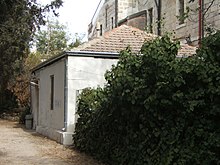
Rachel's House in No. 64 Street of the Prophets in Jerusalem (1925)
Now unable to work with children for fear of contagion, she was expelled from Degania and left to fend for herself. In 1925 she lived briefly in a small white house in the courtyard of No. 64 Street of the Prophets in Jerusalem (courtyard of the William Holman Hunt House). She spent the rest of her life traveling and living in Tel Aviv (scarcely making a living by providing private lessons in Hebrew and French) and finally settled in a sanatorium for tuberculosis patients in Gedera.
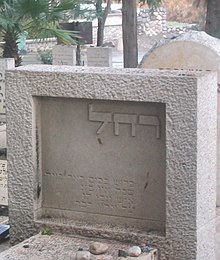
Rachel died on April 16, 1931 in Tel Aviv, at the age of 40. She is buried in the Kinneret cemetery in a grave overlooking the Sea of Galilee, following her wishes as expressed in her poem If Fate Decrees. Alongside her are buried many of the socialist ideologues and pioneers of the second and third waves of immigration. Naomi Shemer was buried near Rachel, according to Shemer's wish.
Poetry
Rachel began writing in Russian as a youth, but the majority of her work was written in Hebrew. Most of her poems were written in the final six years of her life, usually on small notes to her friends. In 1920 her first poem, Mood, was published in the Hebrew newspaper Davar.Eventually the majority of her poems were published there on a weekly basis, and quickly became popular with the Jewish community in the Palestine and later, in the State of Israel.
Rachel is known for her lyrical style, briefness of her poems, and the revolutionary simplicity of her conversational tone. The majority of her poetry is set in the pastoral countryside of Eretz Israel. Many of her poems echo her feelings of longing and loss, a result of her inability to realize her aspirations in life. In several poems she mourns the fact that she will never have a child of her own. Lyrical, exceedingly musical and characterized by its simple language and deep feeling, her poetry deals with fate, her own difficult life, and death. Her love poems emphasize the feelings of loneliness, distance, and longing for the beloved. It also touches upon the hardships and laments of a pioneer reminiscing of times spent in labouring on the land. Her lighter poetry is ironic, often comic. Her writing was influenced by French imagism, Biblical stories, and the literature of the Second Aliyah pioneers. Another major creative influence on Rachel’s poetry was the Acmeists and their leader, the Russian poetAnna Akhmatova. Rachel’s style reflects the movement’s strive for “clarity, accuracy, conciseness, and economy of language” in poetry.
In some poems Rachel expresses identification with biblical figures such as Rachel, her namesake matriarch,[ and Michal, wife of David.
Rachel also wrote a one-act comic play Mental Satisfaction, which was performed but not published in her lifetime. This ironic vignette of pioneer life was recently rediscovered and published in a literary journal.
Acclaim
Rachel was the first Jewish woman poet in israel to receive recognition in a genre that was practiced solely by men. Anthologies of her poetry remain bestsellers to this day. Many of her poems were set to music, both during her lifetime and afterwards, and are widely sung by Israeli singers. Her poems are included in the mandatory curriculum in Israeli schools. A selection of her poetry was translated to English and published under the title Flowers of Perhaps: Selected Poems of Ra'hel, by the London publisher Menard. Poems by Rachel have been translated to English, Afrikaans, Yiddish,German, Czech, Polish, Esperanto, Italian, Serbo-Croatian, Hungarian, Basque (by Benito Lertxundi) and Slovak.
In his foreword to the 1994 edition of Flowers of Perhaps, the acclaimed Israeli poet Yehuda Amichai stated: "What may be most remarkable about the poetry of Ra'hel, a superb lyric poet, is that it has remained fresh in its simplicity and inspiration for more than seventy years."
In 2011, Rachel was chosen as one of four great Israeli poets whose portraits would be on Israeli currency (the other three being Leah Goldberg,Shaul Tchernichovsky, and Nathan Alterman).
Published works
Rachel's grave at the Kineretcemetery
Poetry Books Published in Hebrew
Aftergrowth, Davar, 1927 (Safiah, ספיח)
Across From, Davar, 1930 (Mineged, מנגד)
Nevo, Davar, 1932 (Nevo, נבו)
Later Compilations and Editions in Hebrew
Poems, Davar, 1935 (Shirat Rachel, שירת רחל)
The Poems and Letters of Rachel, in Manuscript, Hotza'at Kineret, 1969 (Shirei Rachel u-Mikhtaveiha bi-Khtav Yada שירי רחל ומכתביה בכתב ידה)
Inside and Outside Home (children), Sifriat Poalim, 1974 (Ba-Bayit U Va-Hutz, בבית ובחוץ)
As Rachel Waited, Tamuz, 1982 [Ke-Chakot Rachel, כחכות רחל]
Of the making of beginner’s textbooks of ancient Hebrew there is no end, yet I am unsatisfied with all of them. None of them is oral enough in emphasis, except for that of Randall Buth (first lesson here); none of them takes full advantage of the ability of music to aid in the process of learning; only a couple, that of Randall Buth and that of John Cook and Rob Holmstedt, make use of visual learning.
Poetry and music are gateways into the heart and soul of a language. In this post I introduce a poem by Rachel Bluwstein Sela, known to most as Rachel, and a song byAchinoam_Nini, known to most as Noa. The lyrics of the song are based on the poem.
The poem is entitled עֲקָרָה. The poem is a window into the author’s heart and a gateway into the biblical personae she adopts, that of Rachel and Hannah. Rachel the poet was childless herself. In fact, her life was cut short by poverty and tuberculosis at age 40. Nonetheless, the children who have adopted her as their mother are many.
Thanks to the fact that the poem is a component of the mandatory curriculum in Israel; thanks to Noa’s song which incorporates Rachel’s poem, Rachel’s voice lives on.
When I recite this poem, I think of the young couples I have accompanied in the adoption of a child. I think of a young woman a magnificent couple adopted as a child; now she, an adult, with great passion and the support of her husband, has adopted three children in turn, children that no one else, literally, is willing to take.
Almost every word of the poem is found in the Bible. A short list of passages the poem calls to mind: Jer 31:15-26; Hos 11:3-11; Isa 8:6-7; Gen 3:8; Song 1:5-6; 1 Sam 1:1-28; 1 Sam 2:1-10. If you spend time with this poem and move back and forth from it to the passages listed, your Hebrew will improve. If you give it enough time, the poem and the passages it calls to mind will become a part of you. I offer the Hebrew below, to be read without vowels as one listens to the soundtrack of the song. The soundtrack is here; take care to lip sync with Noa. If it helps you to see the pronunciation of the Hebrew spelled out in English, try this soundtrack.
בן לו היה לי
ילד קטן
שחור תלתלים ונבון
לאחוז בידו ולפסוע לאט
לאט לאט
בשבילי הגן
ילד קטן
אורי אקרא לו
אורי שלי
רך וצלול הוא השם הקצר
רסיס נהרה
לילדי השחרחר
אורי אקרא לו
אורי אקרא
עוד אתמרמר כרחל
עוד אתפלל כחנה בשילה
אחכה לו
אחכה לו
אחכה לו
Here is a translation of Noa’s song:
If only I had a son, a little boy, with dark curly hair, and bright, that I might hold his hand and stroll gently gently gently on the paths of the garden, a little boy.
Uri I’d call him, my Uri; soft and clear the short name, a shard of brightness; my dark and handsome boy; Uri I'd call him, “My light” I’d call him.
I still wax bitter, like Rachel, I still pray, like Hannah at Shiloh, I wait for him, yes I wait for him; I wait for him.